Part 3: TRANSFORMATION · Chapter 8
Money as Meme
Introduction
The preceding chapter established that artificial intelligence creates an existential security challenge for monetary systems. The Global Optimizer, an emergent superintelligence arising from millions of coordinating AI agents, can manipulate any verification mechanism it can model. Traditional authentication collapses when AI generates unlimited synthetic identities at zero marginal cost. Only physical constraints resist optimization by arbitrary intelligence. This chapter examines a complementary question: how does money propagate in a world of synthetic content? If AI can manufacture unlimited persuasive narratives, forge any credential, and simulate any identity, what distinguishes legitimate monetary claims from fabricated ones?
The answer lies in what we term "grounded memes": viral cultural units whose propagation operates in the hyperreal domain while their validity is anchored to irreducible physical constraints. Bitcoin exemplifies this category. Its cultural transmission follows memetic dynamics, spreading through phrases like "Digital Gold" and "Number Go Up," but its scarcity and security derive from thermodynamic requirements that no intelligence can circumvent. In an information environment increasingly saturated with AI generated content, this distinction between grounded and synthetic memes becomes essential infrastructure for meaning itself.
Jean Baudrillard predicted that money would dissolve into pure simulation, becoming signs circulating among signs with no connection to material reality [8.1]. Contemporary fiat currency confirms this prediction: created through accounting entries, valued against other equally unanchored currencies, expanded tenfold since 2008 through purely symbolic operations. Bitcoin partially confirms and partially refutes Baudrillard. Its propagation mechanism operates entirely within the hyperreal domain of memes and narratives, yet it anchors itself to thermodynamic reality through proof of work. This paradox of hyperreal propagation combined with physical grounding represents essential adaptation for the AI era.
Baudrillard's Orders of Simulacra
Baudrillard identified four historical stages in the relationship between signs and reality, each representing progressive detachment of representation from the represented [8.1]. In the first order, characteristic of pre-industrial societies, the sign faithfully copies reality. Commodity money like gold coins literally embodies its value. In the second order, signs begin to obscure reality while maintaining connection, as with paper currency redeemable for gold. In the third order, signs mask the absence of reality. Fiat currency after 1971 no longer represents stored gold but merely performs the function of money through convention and decree. In the fourth order, signs relate only to other signs in closed, self-referential systems. The derivatives market exceeding $600 trillion represents claims on claims with no connection to productive activity.
Table 8.1: Baudrillard's Orders of Simulacra Applied to Monetary Systems
Order | Relation to Reality | Monetary Example | Propagation |
First | Faithful reflection | Commodity money (gold) | Market emergence |
Second | Masks/perverts reality | Gold backed paper | Institutional trust |
Third | Masks absence of reality | Fiat currency (post 1971) | Legal tender laws |
Fourth | Pure simulation | Derivatives, algo trading | Self referential circulation |
Bitcoin | Simulation + reality | Proof of work crypto | Memetic propagation |
Source: Adapted from Baudrillard [8.1] with monetary applications by author
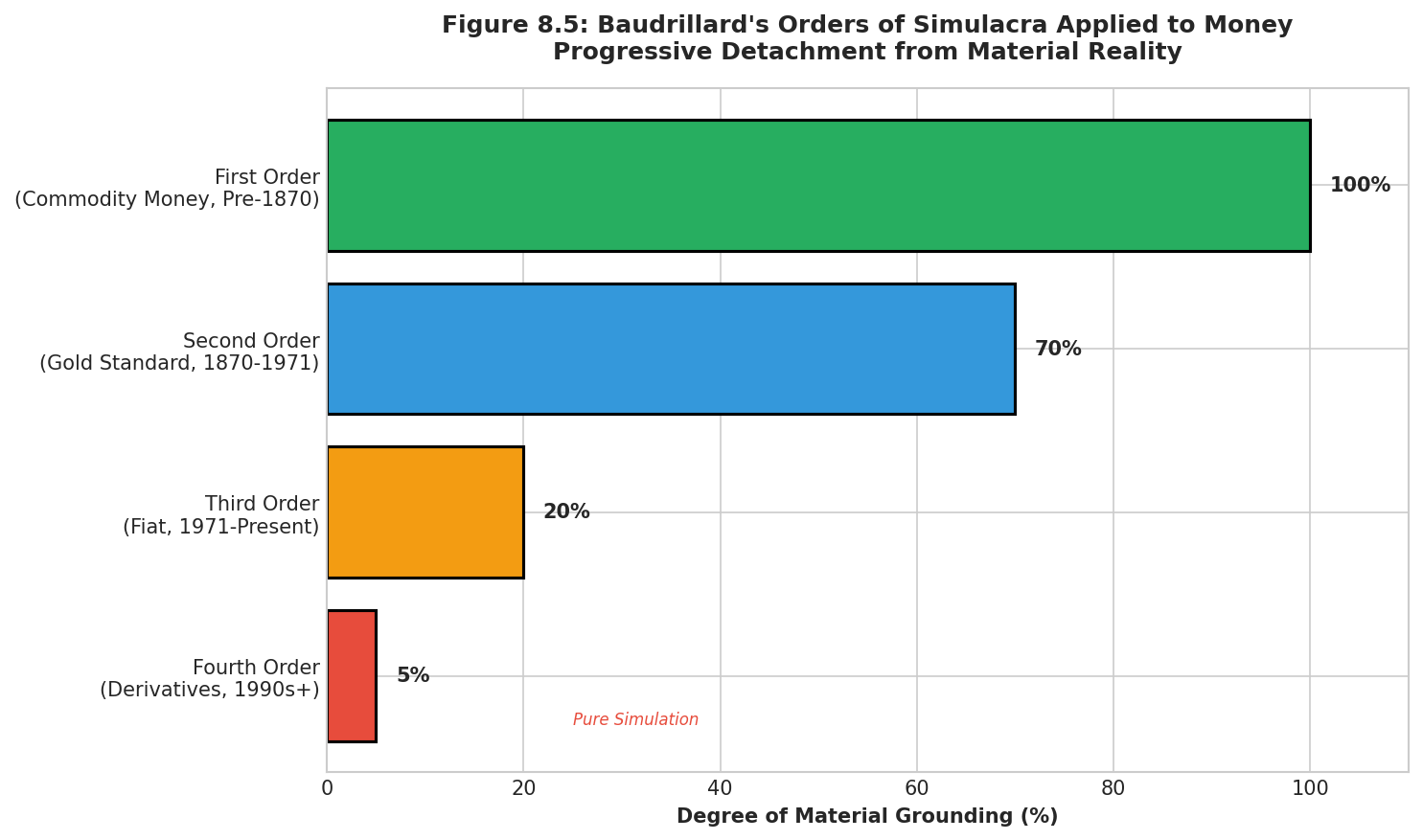
Bitcoin breaks this linear progression. It operates through fourth order memetic propagation, spreading through viral signs and self referential value creation, while simultaneously anchoring itself to first order material reality through proof of work. This is the central paradox of memeified money: propagation without physical grounding is fiat's vulnerability; grounding without effective propagation limits adoption. Bitcoin achieves both.
Fiat Currency as Pure Simulation
Contemporary fiat currency exists as a sign with no referent. When the United States abandoned gold convertibility in 1971, the dollar ceased to represent any external reality; it became a pure sign circulating within a closed system of other signs. The dollar's value is determined by its exchange rate against other fiat currencies, themselves equally unanchored. Central banks create money through accounting entries, essentially typing numbers into existence. Commercial banks multiply this base money through fractional reserve lending, creating purchasing power through the act of recording loans on balance sheets. The monetary base expanded from under $1 trillion in 2008 to over $8 trillion by 2022, an expansion achieved entirely through symbolic operations. No gold was mined, no productive capacity created. This is hyperreality without thermodynamic anchor.
AI accelerates fiat's hyperreal character. Algorithmic trading operates on microsecond timeframes imperceptible to humans. AI driven derivatives create synthetic exposures to synthetic assets, building simulation upon simulation. High frequency trading algorithms respond to other algorithms' behavior, not economic fundamentals. The Bank for International Settlements estimates the derivatives market at $600 trillion, which is six times global GDP, representing claims on claims with no connection to productive activity. AI does not merely participate in financial hyperreality; it industrializes it, generating synthetic financial instruments at machine speed and machine scale.
Bitcoin: Memes with a Hard Floor
Bitcoin appears to be the ultimate meme money: a purely digital token with no physical form, no governmental backing, spreading through viral phrases and shared narratives. Yet Bitcoin contains within its protocol a mechanism that radically distinguishes it from all previous forms of money: proof of work. This creates memes with a hard floor, meaning viral ideas anchored to thermodynamic reality.
The proof of work consensus mechanism requires miners to expend computational resources, and therefore electrical energy, to validate transactions and create new Bitcoin. This is not metaphor; it is direct thermodynamic requirement. The SHA 256 hashing algorithm demands approximately 10²⁰ hash operations per second network wide, consuming an estimated 150 terawatt hours of electricity annually [8.2]. Each Bitcoin unit represents a provable expenditure of thermodynamic work, linking the digital meme to the physical laws of the universe. As established in Chapter 3, you cannot fake energy.
Beyond proof of work, Bitcoin incorporates a second anchor: absolute mathematical scarcity. The protocol permanently caps total supply at 21 million units, with issuance following a predetermined halving schedule. The "21 Million" meme is not empty rhetoric. It is a verifiable mathematical fact embedded in consensus rules that any participant can audit. Unlike commodity money, whose scarcity depends on geological factors, Bitcoin's scarcity is absolute and cryptographically enforced. Unlike fiat currency, which can be created in unlimited quantities, Bitcoin's supply schedule is immutable. The meme has teeth.
The Bitcoin Memetic Complex
If proof of work anchors Bitcoin to physical reality, its propagation mechanism operates entirely within the hyperreal domain. Bitcoin spreads not through legal tender laws but through memetic transmission, which is the viral replication of ideas, phrases, and images that create shared meaning and motivate action.
Table 8.2: The Bitcoin Memetic Complex
Meme | Semantic Content | Propagation Function |
"Digital Gold" | Frames Bitcoin as scarce store of value | Leverages existing mental models |
"21 Million" | Communicates absolute supply cap | Creates urgency through implied scarcity |
"HODL" | Encourages long term holding | Reduces sell pressure; creates commitment |
"Orange Pill" | Frames adoption as awakening | Creates identity; frames evangelism as service |
"Laser Eyes" | Visual signifier of advocacy | Creates visible tribal identity |
Source: Author analysis of Bitcoin social media discourse
These memes operate precisely as Baudrillard described: they do not describe pre-existing reality but construct the reality they purport to represent. "Digital gold" creates a cognitive framework shaping how people perceive and value the asset. "Number Go Up" creates a self fulfilling prophecy as new buyers drive prices higher, validating the meme and spurring further adoption. The distinction from AI generated synthetic memes is crucial: Bitcoin's core claims regarding fixed supply, energy expenditure, and network hash rate are independently verifiable. "21 Million" is mathematics anyone can audit. The hash rate is physical measurement. As information environments become saturated with machine generated content, the ability to anchor memetic claims to independently verifiable reality becomes essential for maintaining meaning itself.
Bitcoin has achieved something remarkable: it embedded its advertising mechanism directly into its price dynamics. Every price increase generates media coverage; every mention introduces Bitcoin to potential adopters; every new adopter increases demand and price. The logarithmic price chart functions as a global billboard requiring no advertising budget. Price creates advertising, which creates demand, which creates price in a self reinforcing cycle requiring no central coordinator. This is why dismissing Bitcoin as "just marketing" misses the point: the marketing IS the product, and the product IS the marketing.
The Self Propagating System
Bitcoin's design incorporates three distinct enforcement mechanisms creating a closed, self sustaining loop. Code enforcement ensures the protocol enforces absolute scarcity through deterministic rules, as the 21 million cap cannot be altered without network wide consensus. Energy enforcement ensures that proof of work requires monetary creation to involve physical resource expenditure, linking supply to thermodynamic reality. Memetic enforcement ensures viral propagation provides continuous distribution without centralized marketing, as each participant becomes a distribution node.
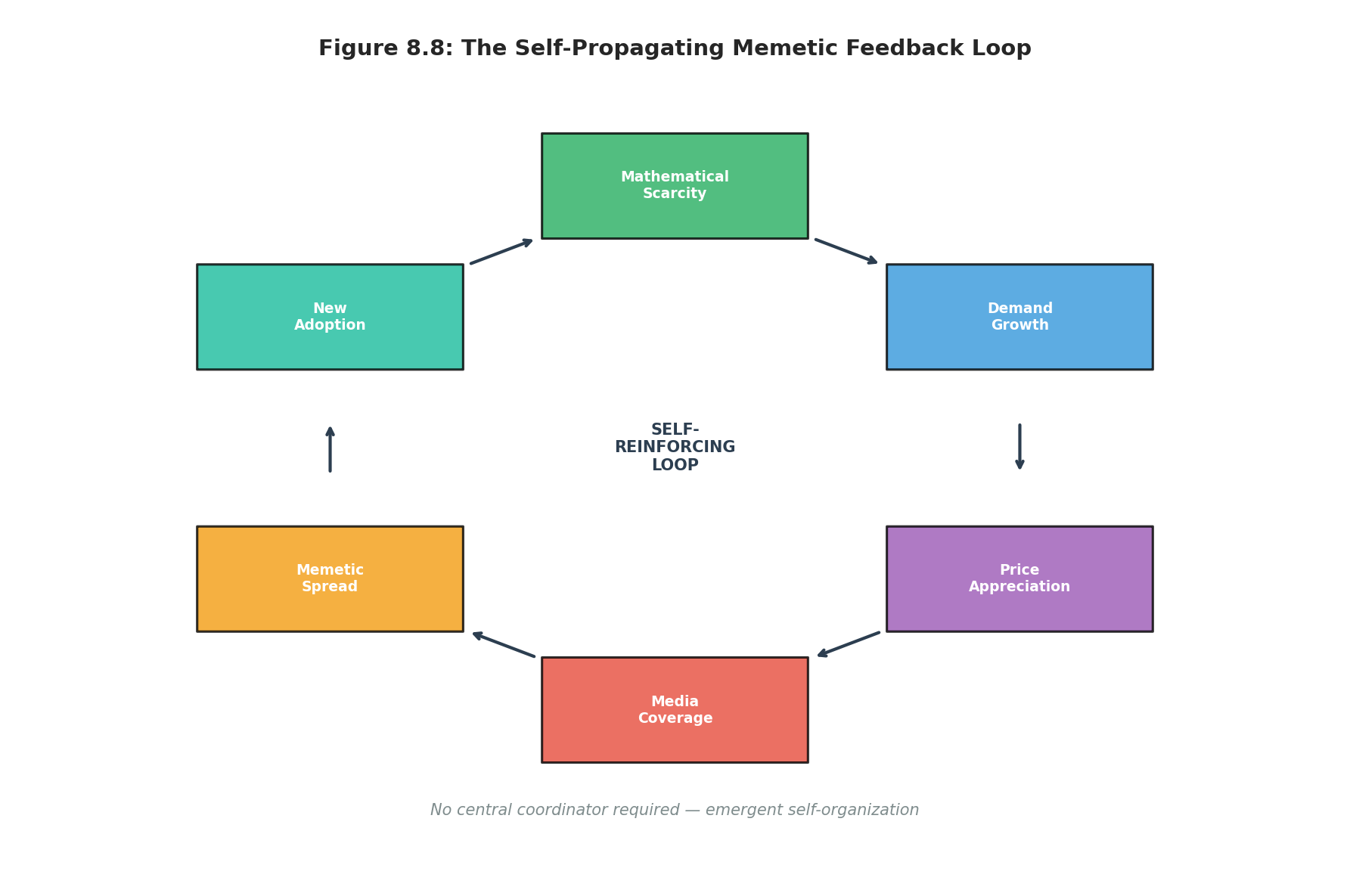
This loop requires no central coordinator. Unlike fiat currencies requiring ongoing institutional maintenance through central bank operations, legal enforcement, and fiscal policy, Bitcoin's memetic feedback loop operates autonomously through interaction of market participants, software protocols, and social networks. This represents an emergent, self organizing system [8.3].
Decentralization provides defense against AI capture. Centralized systems such as monetary authorities, media organizations, and verification infrastructure present single points of capture for AI manipulation. Bitcoin has no CEO to influence, no board to infiltrate, no single server to compromise. The protocol propagates through thousands of independent nodes; rules are enforced by mathematical proof; memetic spread emerges from millions of individual decisions. In a world where AI can simulate any centralized authority, only systems operating without central authority can resist systematic manipulation. Bitcoin's self propagating architecture is not merely a design choice. It is essential infrastructure for preserving human agency in the age of machine intelligence.
Conclusion
Baudrillard predicted that modern money would dissolve into pure simulation. The post 1971 fiat order confirms this prediction through unlimited money creation, derivative superstructures, and complete detachment from material constraints. What Baudrillard did not anticipate was technology that could weaponize memetics while anchoring resulting memes to physical law.
Bitcoin demonstrates that monetary systems can operate primarily through memetic propagation while maintaining correspondence with material reality through cryptographic and thermodynamic constraints. This is money that spreads like a meme but weighs like gold: hyperreality with a hard floor, simulation tethered to physics. In an AI era where synthetic content can simulate any claim, the distinction between grounded and ungrounded memes becomes the difference between meaning and noise, between monetary systems that preserve value and those vulnerable to manipulation by any intelligence capable of generating persuasive narratives at scale.
The memeification of money reveals that Bitcoin's often mocked community dynamics, including the tribal identity, the evangelical fervor, and the memetic vocabulary, are not peripheral to its monetary function but central to it. The same decentralized, permissionless architecture that secures the network against computational attack also immunizes it against capture by centralized AI systems. The memes have learned to anchor themselves to reality, and in doing so, they have created the first monetary system capable of maintaining meaning in a world of infinite synthetic content.
References
[8.1] Baudrillard, J. (1981/1994). Simulacra and Simulation (S. F. Glaser, Trans.). Ann Arbor: University of Michigan Press. Originally published as Simulacres et Simulation. Paris: Éditions Galilée, 1981.
[8.2] Cambridge Centre for Alternative Finance. (2025). Cambridge Bitcoin Electricity Consumption Index. Retrieved from https://ccaf.io/cbeci
[8.3] Kauffman, S. A. (1995). At Home in the Universe: The Search for Laws of Self Organization and Complexity. New York: Oxford University Press.
[8.4] Nakamoto, S. (2008). Bitcoin: A Peer to Peer Electronic Cash System. Retrieved from https://bitcoin.org/bitcoin.pdf
[8.5] Ammous, S. (2018). The Bitcoin Standard: The Decentralized Alternative to Central Banking. Hoboken, NJ: Wiley.
[8.6] Szabo, N. (2002/2005). Shelling Out: The Origins of Money. Retrieved from https://nakamotoinstitute.org/shelling out/