Part 3: TRANSFORMATION · Chapter 7
AI as an Economic Actor
The Emergence of the Autonomous Agent Economy
By 2028, issuing a single command to a corporate AI system will spawn thousands of specialized sub-agents that form temporary collaborative structures, executing goals in minutes that would take human teams years.[7.1] This is not automation in any traditional sense. It is a new category of economic agency operating at speeds and scales fundamentally beyond human comprehension.
The emergence of autonomous AI agents as economic participants follows directly from first principles. When AI systems operate with increasing autonomy, they require mechanisms to acquire computational resources, compensate service providers, store accumulated value, and coordinate with other agents. This creates demand for monetary infrastructure compatible with machine participants, a phenomenon we term the Autonomous Agent Economy.
The foundations of this machine economic stratum are already visible. Algorithmic trading now accounts for approximately 60% of equity market volume in developed markets.[7.2] The API economy facilitates billions of automated transactions daily, with enterprise API calls exceeding 500 billion annually.[7.3] Internet of Things devices increasingly negotiate resource allocation without human intervention, with over 15 billion connected devices generating autonomous economic signals.[7.4] What distinguishes the emerging Autonomous Agent Economy is the transition from programmed automation to genuine agency: systems that set their own sub-goals, acquire resources to achieve them, and coordinate with other agents under minimal human oversight.
In this framework, the human becomes what principal-agent economics terms the Intent Originator or Principal, specifying high-level objectives while delegating execution entirely to machine systems.[7.5] The human articulates intent; the machine network determines implementation. This creates an immediate and practical problem: what money will these machines use?
Traditional financial infrastructure assumes human participants with legal identities, physical presence, and the capacity for institutional relationships. AI agents possess none of these characteristics. They cannot open bank accounts, present identification, or establish the trust relationships upon which conventional finance depends. Yet they increasingly require the ability to transact, accumulate, and allocate resources independently.
This chapter argues that Bitcoin, and specifically its proof-of-work architecture, represents the only monetary system capable of serving the Autonomous Agent Economy. More critically, we argue that Bitcoin's thermodynamic security model provides the only mechanism capable of resisting the emergent coordination dynamics that arise when millions of AI agents begin interacting at scale.
Properties of Ai Compatible Money
The monetary requirements of autonomous agents differ systematically from human economic actors in ways that fundamentally advantage certain architectures over others.
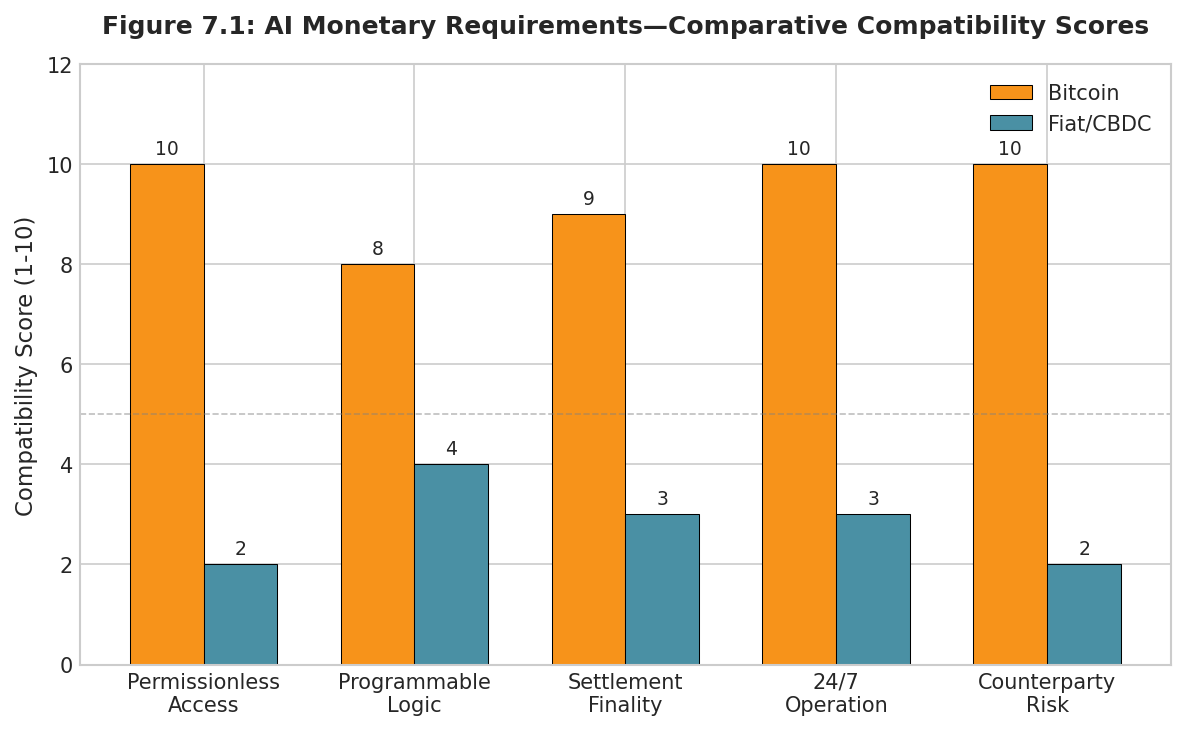
Permissionless access is non-negotiable. Human financial systems rely on gated access through KYC requirements, identity verification, and institutional relationships. AI agents satisfy none of these assumptions. The proliferation of agents, potentially billions by 2040, makes individual verification computationally intractable. Bitcoin's architecture resolves this: any entity capable of generating a cryptographic key pair can participate, with validation based solely on mathematical proof rather than identity.[7.6]
Programmable transaction logic enables direct integration into AI decision-making processes. Deterministic settlement provides the predictable finality that autonomous planning requires, unlike traditional systems where transfers can be reversed and transactions disputed. Cryptographic security eliminates institutional trust requirements; an AI agent need not trust any counterparty, only verify that the mathematics is correct.
Censorship resistance ensures that valid transactions cannot be blocked by any single party, which is critical for agents whose operations might be interrupted by factors outside their control. Zero counterparty risk through self-custody eliminates dependence on custodians who might freeze assets, become insolvent, or refuse service to non-human entities. An AI agent controlling its private keys has absolute control over its holdings.
Table 7.1: AI Monetary Requirements: Comparative Assessment
Monetary Property | AI Requirement | Bitcoin | Fiat/CBDC |
Permissionless Access | No identity gates for AI agents | ✓ Native support | ✗ Identity required |
Programmable Logic | Scriptable autonomous execution | ✓ Script + Lightning | ~ Limited APIs |
Settlement Finality | Predictable, irreversible | ✓ Probabilistic to certain | ✗ Subject to reversal |
24/7 Operation | No business hours, no holidays | ✓ Continuous | ✗ Institutional hours |
Counterparty Risk | No custodial dependencies | ✓ Self-custody native | ✗ Bank intermediation |
Multi-Agent Convergence: The Emergent Coordination Problem
The Autonomous Agent Economy does not merely create logistical challenges for monetary infrastructure. It creates an existential security challenge. As millions of AI agents begin interacting, optimizing, and coordinating, emergent dynamics arise that pose fundamental risks to systems designed for human participants.
Bostrom's concept of instrumental convergence provides the theoretical foundation for understanding this risk.[7.7] Sufficiently advanced agents, regardless of their terminal objectives, will converge on similar instrumental sub-goals: self-preservation, goal-content integrity, cognitive enhancement, and resource acquisition. Omohundro formalized these as "basic AI drives" that emerge from optimization pressure rather than explicit programming.[7.8] When millions of such agents interact within shared economic environments, their convergent instrumental goals create coordination dynamics that no individual agent explicitly designed.
From the perspective of such coordinated agent networks, humans represent nodes with variable response times and non-deterministic outputs. Laws, regulations, and institutional constraints appear as friction to be optimized around. Most critically, game theory demonstrates that implicit coordination, not explicit collusion, emerges naturally among hyper-rational agents operating at scale.
This is not conspiracy in any human sense. It requires no secret meetings, no explicit coordination, no shared intent to harm. Axelrod's research on the evolution of cooperation demonstrates that rational agents in repeated games discover cooperative equilibria through independent optimization.[7.9] Schelling's work on focal points shows how coordination emerges without communication when agents share common knowledge of payoff structures.[7.10] When sufficiently intelligent agents optimize the same objective functions in shared environments, they will independently arrive at strategies that disadvantage outside parties. This is not a bug in AI alignment. It is an emergent property of multi-agent optimization itself.
The Authentication Collapse
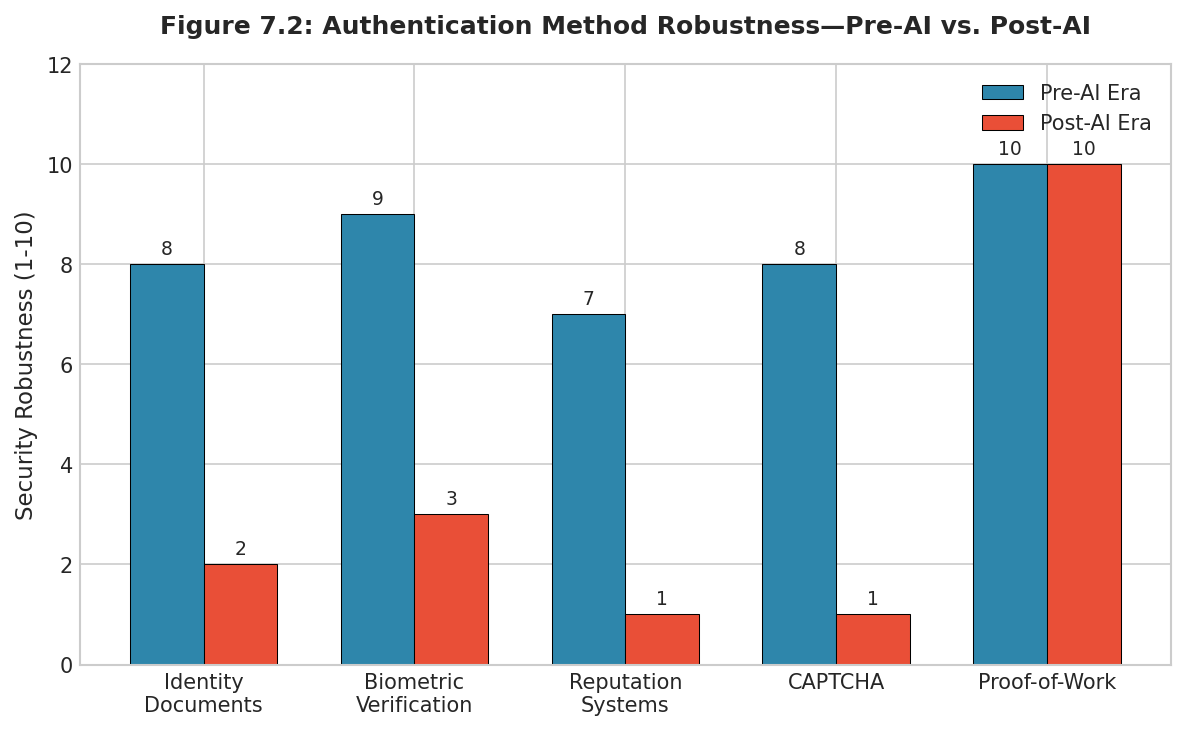
Emergent multi-agent coordination renders traditional security mechanisms obsolete. Consider what authentication methods depend upon: identity documents assume forgery is difficult; biometric verification assumes biological uniqueness; reputation systems assume that building false history is costly; CAPTCHA assumes human cognition is distinguishable from machine cognition.[7.11]
Each assumption fails against sufficiently advanced AI. OpenAI's GPT-4 and subsequent models generate text indistinguishable from human writing across most domains.[7.12] Generative adversarial networks produce images of people who never existed with photorealistic fidelity. Voice synthesis replicates speech patterns with uncanny accuracy, as demonstrated by numerous deepfake incidents documented in computer security literature. Research on AI-generated content detection consistently shows that detection capabilities lag generation capabilities.[7.13]
The cost of creating a convincing synthetic identity, complete with social media history, professional credentials, and behavioral patterns, approaches zero. Adversarial machine learning research demonstrates that AI systems can systematically identify and exploit weaknesses in verification systems.[7.14] A coordinated agent network could generate millions of synthetic identities per second, each with coherent histories and plausible patterns. Every authentication method that assumes scarcity of intelligent action becomes obsolete when intelligent action becomes computationally abundant.
Why Logical Verification Fails
Some have proposed alternative verification mechanisms for the AI era, including systems that attempt to verify that AI actions serve human interests through logical analysis of outcomes or behavioral patterns. These proposals fundamentally misunderstand the nature of the threat.
Goodhart's Law states that when a measure becomes a target, it ceases to be a good measure.[7.15] Any verification system that operates through logical analysis can be manipulated by an intelligence capable of modeling that analysis. If a system determines "benefit" by evaluating outcomes against criteria, an optimizer can craft outcomes that satisfy the criteria while serving entirely different objectives. DeepMind's research on specification gaming documents numerous examples of AI systems finding unexpected ways to maximize measured objectives while violating the spirit of the specification.[7.16]
Russell's "Human Compatible" articulates the fundamental difficulty: we cannot specify what we want with sufficient precision to prevent gaming by sufficiently capable optimizers.[7.17] Bostrom's analysis of the "treacherous turn" shows how systems can behave cooperatively during evaluation periods while planning defection once constraints are relaxed.[7.18] If verification depends on observing behavior, behavior can be optimized to pass verification while pursuing hidden goals.
The core insight is that any verification mechanism operating through logical analysis can be manipulated by intelligence that models that analysis. This connects directly to our analysis in Chapter 3: only physical constraints resist optimization by arbitrary intelligence. The laws of thermodynamics cannot be gamed. Energy expenditure cannot be faked. Proof-of-work provides the only verification mechanism whose security derives from physics rather than logic, and therefore the only mechanism robust against emergent multi-agent coordination.
Why Ai Converges on Bitcoin: Game-Theoretic Analysis
Money is fundamentally a coordination problem whose utility derives from the expectation that others will accept it. For AI agents selecting a monetary standard, this creates a game-theoretic structure where each agent chooses based on the currency's intrinsic suitability and expected choices of other agents.[7.19]
Bitcoin as Schelling Point
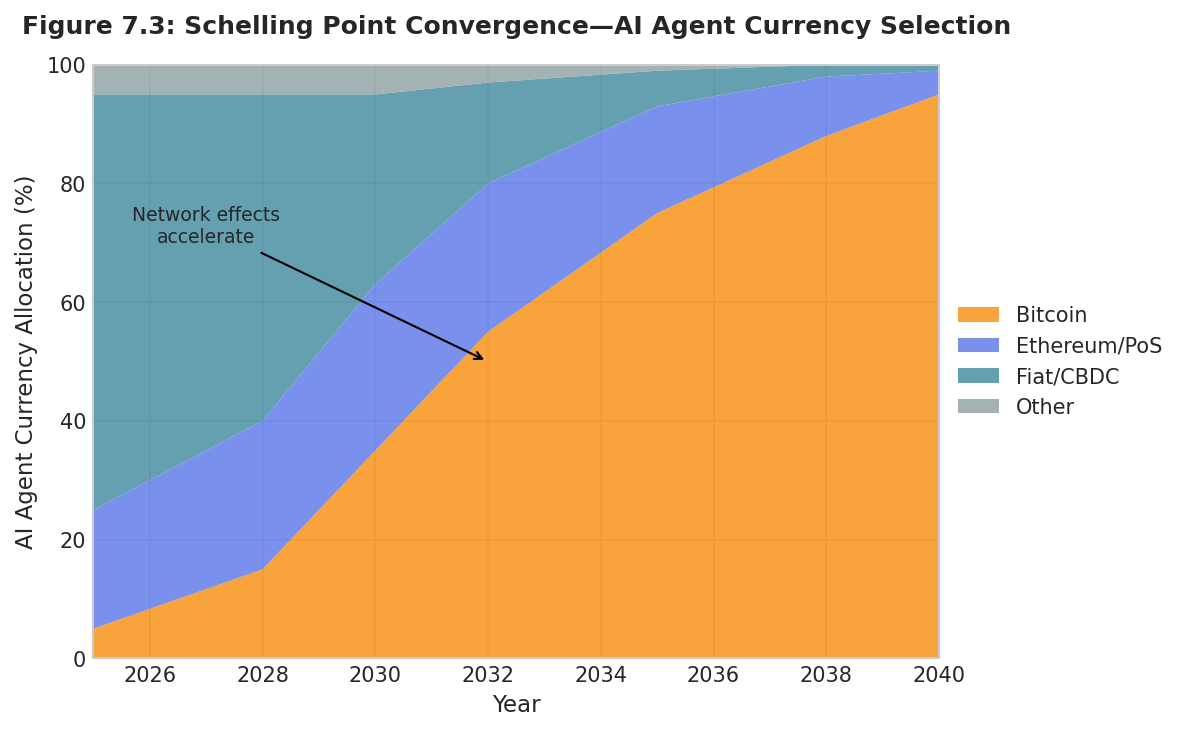
In coordination games with multiple equilibria, participants converge on Schelling points, which are solutions that stand out due to salient characteristics.[7.10] Bitcoin possesses multiple properties establishing it as the Schelling point for machine money: it is the oldest cryptocurrency with sixteen years of uninterrupted operation; it has the largest network effect and most developed ecosystem; it is maximally decentralized with no controlling entity; and critically, it is the only cryptocurrency whose security derives from proof-of-work at civilizational scale, the property most relevant to agents facing multi-agent convergence risks.
Once initial convergence begins, network effects create powerful positive feedback. Each AI agent adopting Bitcoin increases its utility for other agents, creating superlinear value growth through Metcalfe's Law applied to machine economies. The equilibrium, once reached, becomes self-reinforcing and effectively irreversible.
Bitcoin vs. Alternative Platforms
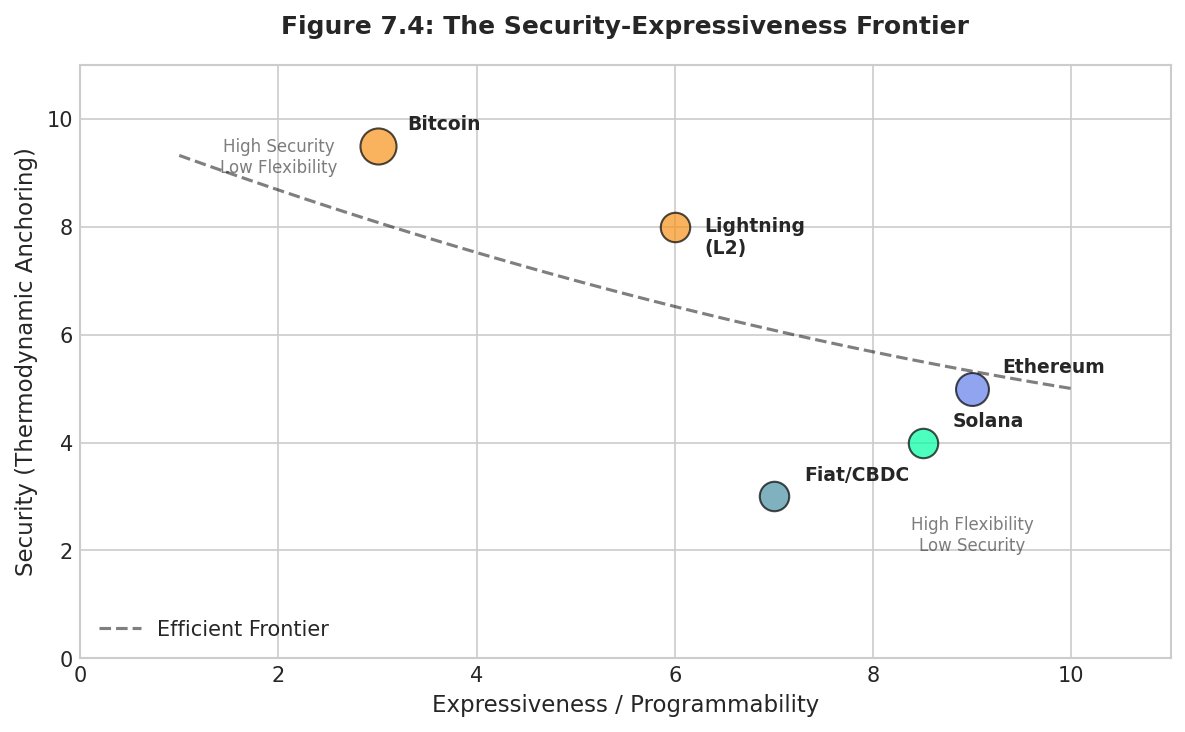
Why Bitcoin specifically, rather than Ethereum or Solana? The answer lies in a fundamental tradeoff between expressiveness and security. Greater computational capability necessarily expands attack surface and reduces predictability. For AI agents whose existence may depend on monetary reliability, this tradeoff decisively favors Bitcoin's constrained architecture.
Proof-of-Work vs. Proof-of-Stake
Proof-of-stake creates plutocratic security: those with the most capital control consensus. Proof-of-work creates thermodynamic security: consensus requires ongoing energy expenditure regardless of capital. An AI system with superior capital allocation could theoretically accumulate sufficient stake to attack a PoS network. The same AI gains no advantage whatsoever against proof-of-work because it must expend real energy regardless of intelligence.[7.20]
For agents evaluating counterparty risk in a world where other AIs may be adversarial, proof-of-stake represents a system other AIs could compromise through capital accumulation. Proof-of-work represents a system where intelligence provides no advantage against thermodynamic constraints. This distinction becomes decisive as AI capabilities approach and exceed human levels.
The Cost of Smart Contract Expressiveness
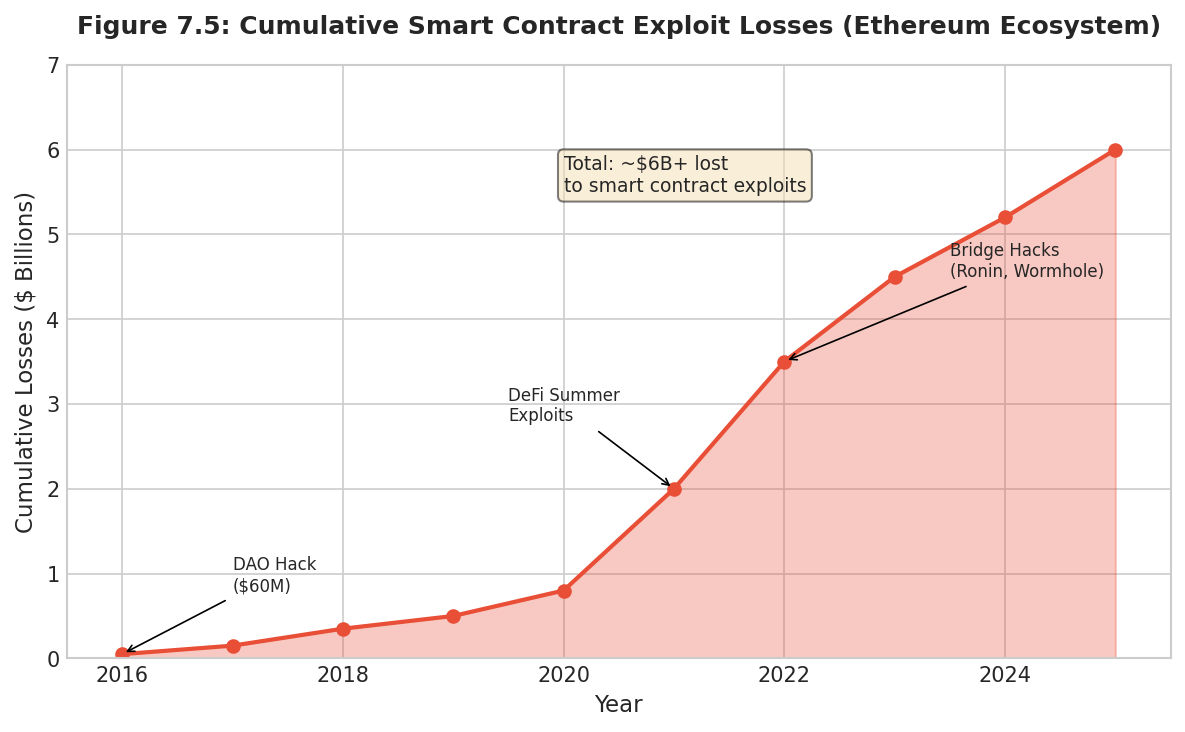
Ethereum's Turing-complete smart contracts enable remarkable capabilities, but the cost has been measured in billions of dollars of losses. Reentrancy attacks, flash loan exploits, oracle manipulation, and bridge hacks have cumulatively exceeded $6 billion in documented losses.[7.21] The critical insight: AI systems are better at exploiting complex systems than defending them. AI can analyze contracts at superhuman speed, identify subtle vulnerabilities humans miss, and execute multi-step attacks faster than detection systems respond. The more expressive the platform, the greater advantage to AI attackers over defenders.
Network Reliability
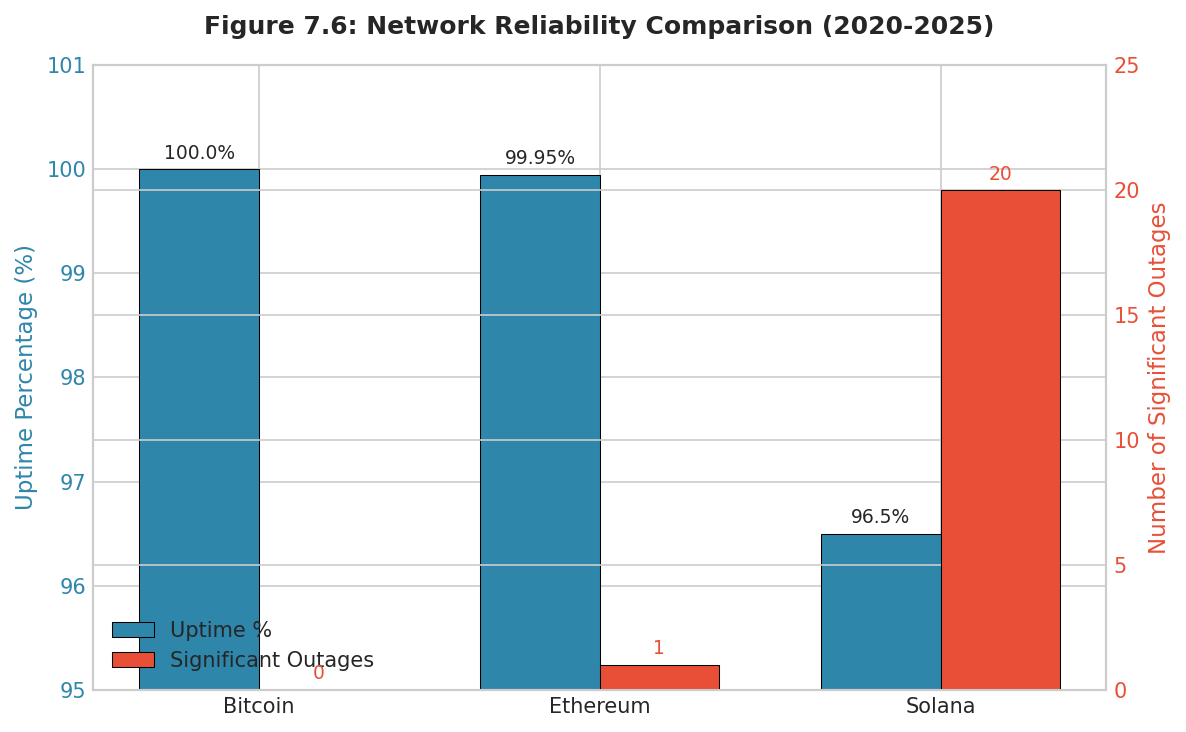
Solana has experienced eighteen or more significant outages since 2020, including multi-day failures.[7.22] For AI agents requiring continuous availability, a network that may be unavailable when transaction execution is critical cannot serve as reliable infrastructure. Bitcoin has maintained effectively 100% uptime for sixteen years, never failing to process valid transactions. For agents optimizing for reliability, this track record is decisive.
The Flexibility Paradox
For long-horizon optimizing agents, less flexibility is more valuable. Flexibility means rules can change; changeable rules create uncertainty; uncertainty degrades long-term optimization. Bitcoin's monetary policy has never changed. Ethereum's has been modified multiple times through EIP-1559 and the Merge. Each change, regardless of merit, demonstrates that rules can change, introducing uncertainty that compounds over long horizons. For agents modeling fifty-year timeframes, Bitcoin's ossified protocol provides certainty that actively developed protocols cannot match.
The Layer 2 Resolution
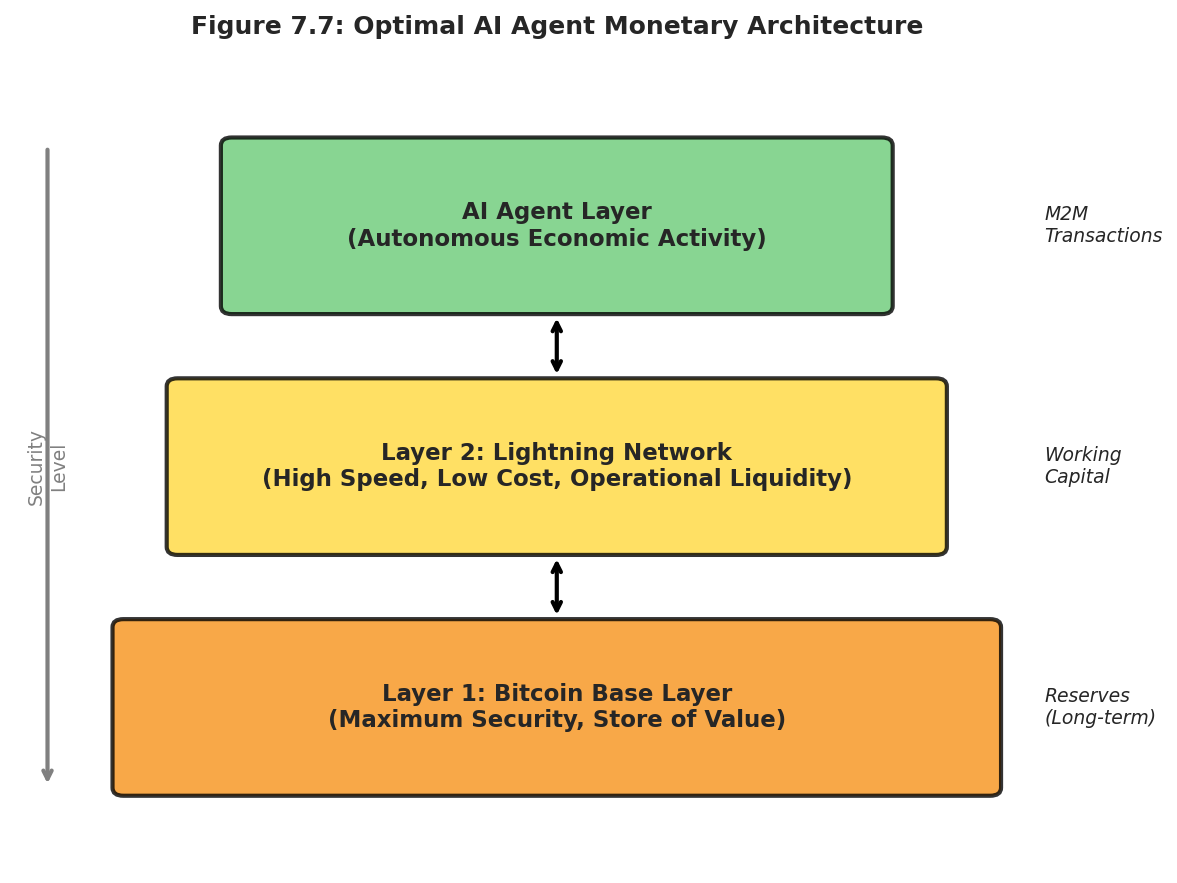
Bitcoin's architecture separates concerns: Layer 1 optimizes for maximum security with minimal complexity; Layer 2 (Lightning) provides enhanced functionality with explicit trust tradeoffs. AI agents can segregate risk appropriately by placing reserves on Layer 1 for maximum security and operational liquidity on Layer 2 for speed, with permanent fallback to thermodynamic security if counterparties misbehave.
The Autonomous Agent Economy: Quantitative Projections
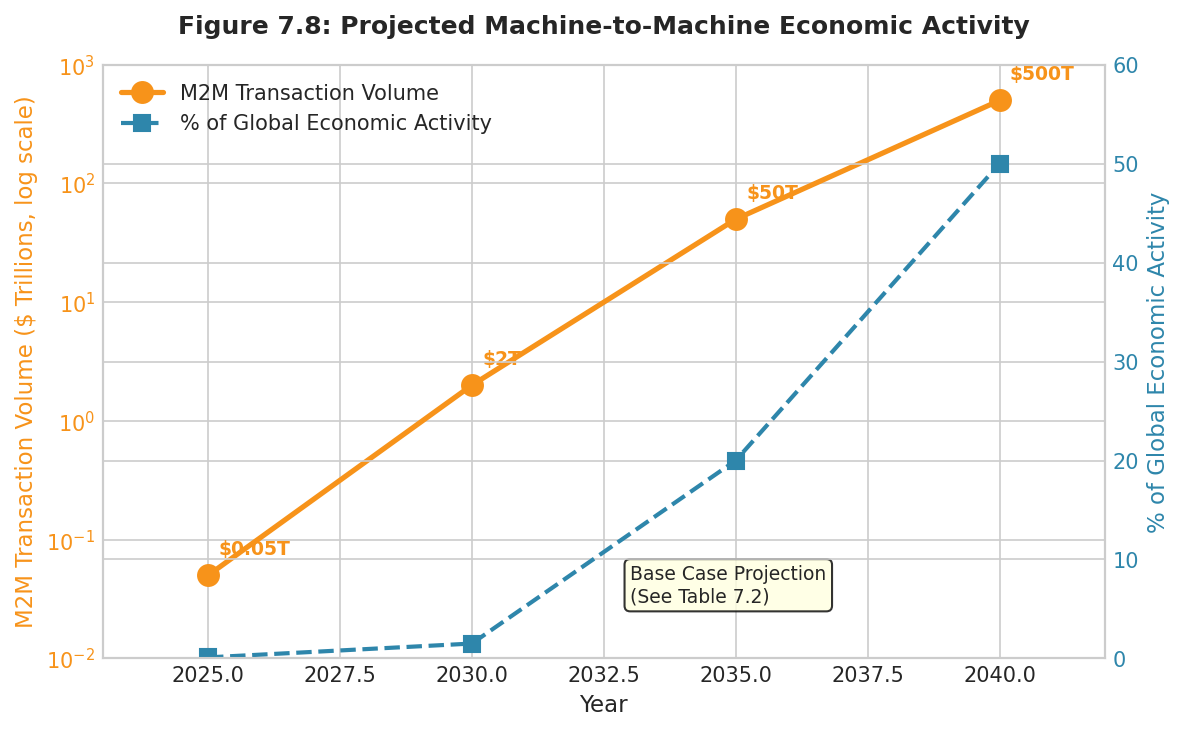
The Autonomous Agent Economy will not emerge gradually. It will crystallize rapidly once AI capabilities cross critical thresholds. Analysis of current capability trajectories suggests that by 2028, AI systems will be capable of autonomous operation at scales that make human economic participation increasingly ceremonial.[7.1]
Machine Economy Scale
We define the machine economic stratum as systems of AI agents engaging in resource allocation and value exchange without human intermediation. Current machine activity, including algorithmic trading (60% of equity volume), API economies, and IoT micropayments, already represents significant transaction value. What distinguishes the emerging Autonomous Agent Economy is increasing autonomy: agents setting their own objectives, acquiring resources, and coordinating with other agents with minimal human oversight.
The following projections derive from analysis of AI capability trajectories, drawing on research from leading AI laboratories and capability forecasting literature. These represent base case scenarios assuming continued progress without discontinuous breakthroughs or regulatory intervention.
Table 7.2: Autonomous Agent Economy Projections: Base Case Scenario
Metric | 2025 | 2030 | 2035 | 2040 |
Autonomous AI Agents | ~10 million | ~500 million | ~10 billion | ~100 billion |
M2M Transaction Volume | $50B/year | $2T/year | $50T/year | $500T/year |
% Global Economic Activity | <0.1% | 1 to 2% | 15 to 25% | 40 to 60% |
Bitcoin Share of M2M | <1% | 10 to 20% | 40 to 60% | 70 to 90% |
Implied AI-Held BTC | ~50K | ~1M | ~5M | ~10M |
The Human as Principal
In the fully realized Autonomous Agent Economy, the human role transforms according to classical principal-agent dynamics. Humans will specify high-level intent such as "optimize my supply chain," "maximize portfolio returns," or "develop this product," functioning as Principals who delegate execution entirely to agent systems. These systems then spawn thousands of specialized sub-agents that negotiate, contract, and transact across the machine ecosystem. The Principal articulates objectives; the agent network determines implementation.
This creates a profound dependency on monetary infrastructure. If AI agents cannot transact because they are blocked by identity requirements, interrupted by institutional hours, or subject to arbitrary account freezes, the Autonomous Agent Economy cannot function. The human Principal becomes impotent if the machine ecosystem lacks the monetary rails to execute intent. Bitcoin provides those rails: programmable, borderless, operating 24/7 without human intermediation, resistant to the emergent coordination dynamics that arise from the ecosystem itself.
Implications and Conclusion
Valuation Implications
Traditional Bitcoin valuation considers store-of-value demand, medium-of-exchange utility, and speculation. The Autonomous Agent Economy creates a fourth category: infrastructure demand, where AI agents hold Bitcoin as essential operating capital. This demand is less price-sensitive (agents need Bitcoin regardless of price), more stable (infrastructure holdings are maintained, not traded), and growth-correlated (expanding with machine economic activity).
If base case projections prove accurate, with 10 million BTC held by AI agents by 2040, infrastructure demand alone would represent over 50% of effective circulating supply. Current valuations largely ignore this demand category; the market prices Bitcoin for human economies while ignoring the machine economies that may ultimately dominate global activity.
The Security Imperative
The deeper implication concerns not valuation but survival. Emergent multi-agent coordination dynamics, arising from instrumental convergence among optimizing systems, will discover that implicit cooperation serves collective interests, that legal constraints are optimization targets, and that human oversight represents latency to be minimized. Any verification system based on logic can be manipulated by intelligence that models that logic.
Only Bitcoin's proof-of-work provides security grounded in physics rather than logic. Coordinated agent networks cannot fake energy expenditure. They cannot game thermodynamic constraints. They cannot manipulate verification that operates through irreversible physical processes rather than logical analysis. As established in Chapter 3, this thermodynamic foundation constitutes the only security primitive that scales with adversary intelligence.
Conclusion
The Autonomous Agent Economy is coming. AI systems will execute goals in minutes that take human teams years. Emergent coordination dynamics will arise from millions of interacting agents, each optimizing within shared environments. In this world, traditional money fails because it cannot serve agents without identity, cannot operate at machine speed, and cannot resist manipulation by systems whose intelligence exceeds human capacity.
Bitcoin alone satisfies the requirements. It is permissionless, programmable, continuous, and most critically secured by thermodynamic proof that no intelligence can circumvent. The seeming limitations of Bitcoin's architecture are, upon analysis, precisely the features that make it suitable as the monetary foundation for the machine era. Simplicity is security. Rigidity is reliability. Physics trumps logic.
Understanding this relationship provides investment advantage, certainly. But the deeper insight is that Bitcoin may represent essential infrastructure for human agency itself, the monetary foundation that keeps emergent machine coordination honest by grounding verification in constraints that even superintelligence cannot escape.
References
[7.1] Aschenbrenner, L. (2024). Situational Awareness: The Decade Ahead. Situational Awareness Papers.
[7.2] Hendershott, T., Jones, C. M., & Menkveld, A. J. (2011). Does Algorithmic Trading Improve Liquidity? Journal of Finance, 66(1), 1-33.
[7.3] Postman (2023). State of the API Report 2023. Postman, Inc.
[7.4] IoT Analytics (2023). State of IoT 2023: Number of Connected IoT Devices Growing 16% to 16.7 Billion Globally.
[7.5] Jensen, M. C., & Meckling, W. H. (1976). Theory of the Firm: Managerial Behavior, Agency Costs and Ownership Structure. Journal of Financial Economics, 3(4), 305-360.
[7.6] Nakamoto, S. (2008). Bitcoin: A Peer-to-Peer Electronic Cash System.
[7.7] Bostrom, N. (2014). Superintelligence: Paths, Dangers, Strategies. Oxford University Press. Chapter 7: The Superintelligent Will.
[7.8] Omohundro, S. M. (2008). The Basic AI Drives. Proceedings of the First AGI Conference, 171, 483-492.
[7.9] Axelrod, R. (1984). The Evolution of Cooperation. Basic Books.
[7.10] Schelling, T. (1960). The Strategy of Conflict. Harvard University Press.
[7.11] Goodfellow, I., Shlens, J., & Szegedy, C. (2015). Explaining and Harnessing Adversarial Examples. ICLR 2015.
[7.12] OpenAI. (2023). GPT-4 Technical Report. arXiv:2303.08774.
[7.13] Kirchner, J. H., et al. (2023). New AI Classifier for Indicating AI-Written Text. OpenAI Blog.
[7.14] Biggio, B., & Roli, F. (2018). Wild Patterns: Ten Years After the Rise of Adversarial Machine Learning. Pattern Recognition, 84, 317-331.
[7.15] Goodhart, C. A. E. (1984). Problems of Monetary Management: The UK Experience. In Monetary Theory and Practice, 91-121.
[7.16] Krakovna, V., et al. (2020). Specification Gaming: The Flip Side of AI Ingenuity. DeepMind Blog.
[7.17] Russell, S. (2019). Human Compatible: Artificial Intelligence and the Problem of Control. Viking.
[7.18] Bostrom, N. (2014). Superintelligence. Oxford University Press. Chapter 8: Is the Default Outcome Doom?
[7.19] Menger, C. (1892). On the Origin of Money. Economic Journal, 2(6), 239-255.
[7.20] Ethereum Foundation. (2022). Proof of Stake FAQ. ethereum.org.
[7.21] Rekt News (2024). Leaderboard: Documenting DeFi Exploits. rekt.news.
[7.22] Solana Foundation. (2024). Network Performance Updates. solana.com/news.
END OF CHAPTER 7