Part 1: FOUNDATIONS · Chapter 3
Time Preference: The Root Variable of Civilization
"No matter what a person's original time-preference rate or what the original distribution of such rates within a given population, once it is low enough to allow for any savings and capital or durable consumer-goods formation at all, a tendency toward a fall in the rate of time preference is set in motion, accompanied by a 'process of civilization.'"
— Hans-Hermann Hoppe, Democracy: The God That Failed (2001)
Introduction
Every economic decision is fundamentally a decision about time. When an individual chooses to save rather than consume, to invest rather than spend, or to build rather than extract, they are making a temporal choice—sacrificing present satisfaction for anticipated future benefit. This elementary observation contains within it the seed of a profound insight: the temporal orientation of economic actors collectively determines the character and trajectory of their civilization.
Austrian economists recognized this truth long before Bitcoin existed. The concept of time preference—the degree to which an individual values present satisfaction over future satisfaction—emerged as a central pillar of Austrian capital theory in the late nineteenth century. Hans-Hermann Hoppe, in Democracy: The God That Failed (2001), synthesized these insights into a comprehensive theory linking time preference to civilizational development [3.1]. This chapter applies that framework to demonstrate why Bitcoin's thermodynamic anchoring uniquely enables low time preference at civilizational scale.
The Austrian School Foundation
The systematic study of time preference in economics originates with Eugen von Böhm-Bawerk's Capital and Interest (1884), which established that the phenomenon of interest arises from the universal human tendency to value present goods more highly than future goods of equal quantity and quality [3.2]. Ludwig von Mises extended this analysis in Human Action (1949), integrating time preference into his comprehensive praxeological framework [3.3].
Hoppe's contribution was to recognize the reflexive relationship between time preference and capital accumulation—a positive feedback loop that he identified as the engine of civilizational progress. Once time preference falls sufficiently to permit savings and capital formation, a self-reinforcing cycle begins: accumulated capital increases productivity, raises living standards, and further reduces time preference, enabling additional savings and continued progress [3.1].
Empirical Evidence: Psychology and History
The most influential empirical research on time preference in psychology originated with Walter Mischel's delayed gratification studies at Stanford University, conducted between 1968 and 1974. Children who demonstrated the ability to delay gratification showed significantly better life outcomes across multiple dimensions—higher SAT scores, better social competence, and superior stress management [3.5].
Critically, subsequent research demonstrated that time preference responds to environmental conditions. The Rochester replication study placed children in either "reliable" or "unreliable" experimental conditions before the marshmallow test. Children in the unreliable condition (where experimenters broke promises) waited approximately one-quarter as long as those in the reliable condition. The children were not demonstrating inferior character; they were rationally responding to demonstrated institutional unreliability. When trust is deficient, high time preference is adaptive [3.5].
Historical evidence supports the macroeconomic manifestation of this principle. European interest rates declined from approximately 8% in the thirteenth century to 2.5% in the nineteenth century [3.1]. This secular decline reflects falling aggregate time preference as capital accumulated, institutions strengthened, and monetary systems provided reliable stores of value. The physical evidence is equally visible: cathedrals that took centuries to complete, infrastructure designed to serve generations, legal codes intended to outlive their authors.
Fiat Currency and Systematic Capital Destruction
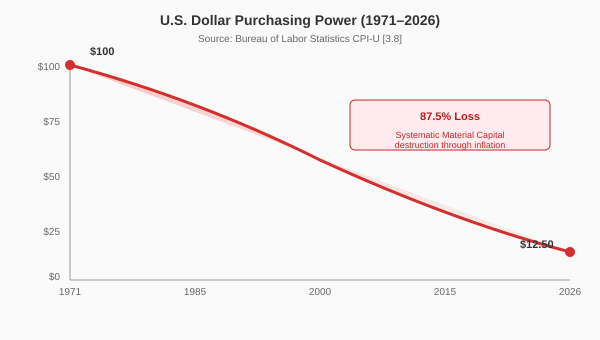
Fiat monetary systems systematically degrade the conditions necessary for low time preference. According to Bureau of Labor Statistics CPI data, $100 saved in 1971 retains only $12.50 of purchasing power in 2026—an 87.5% destruction of stored value [3.6]. This is not abstract economics—it represents the systematic expropriation of human time. The rational response to guaranteed currency depreciation is to minimize savings, increase consumption, and seek alternative stores of value—precisely the high time preference behaviors that Hoppe identifies with de-civilization.
When monetary authorities repeatedly demonstrate willingness to inflate away obligations, institutional trust erodes. Savers learn that promises denominated in fiat currency cannot be trusted across time. Contracts become less reliable. The social infrastructure enabling long-term planning deteriorates. As Ammous documents, hyperinflationary environments destroy not just economies but social fabric itself—fruit-bearing trees chopped for firewood, seed corn eaten, the future discounted toward zero [3.4].
Table 3.1: Fiat Currency Effects on Time Preference
Fiat Mechanism | Effect on Savers | Time Preference Impact |
Inflation (currency debasement) | Purchasing power erodes over time | Increases (+): Savings punished |
Interest rate suppression | Returns below inflation | Increases (+): Consumption incentivized |
Bail-outs and money printing | Trust in institutions erodes | Increases (+): Contracts unreliable |
Asset price inflation | Housing, stocks as money substitutes | Increases (+): Speculation required |
Note: (+) indicates time preference increases, leading to present-oriented behavior.
The Civilization Feedback Loop
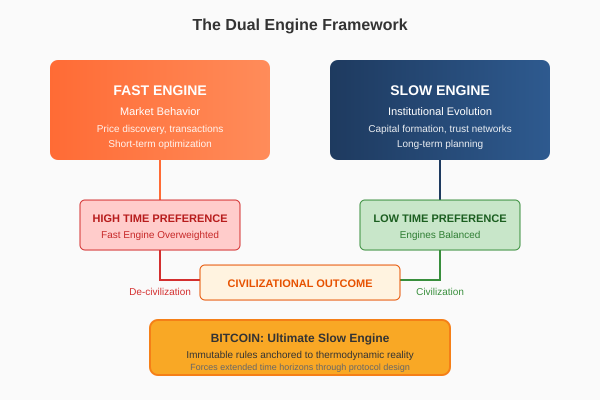
Hoppe's central insight is that time preference and capital accumulation exist in a reflexive relationship—a positive feedback loop in which each variable reinforces the other [3.1]. When time preference falls sufficiently to permit savings, capital accumulates, productivity rises, living standards improve, and time preference falls further. This is the engine of civilizational progress.
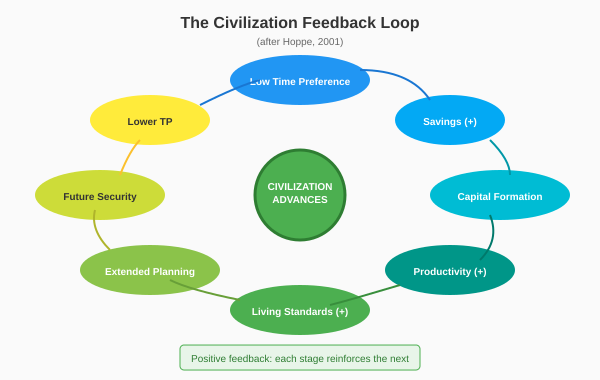
The inverse loop is equally powerful. When circumstances cause individuals to view savings as unsafe, time preferences rise. Capital is consumed. Planning horizons shrink. Infrastructure decays. Each degradation makes the next more likely. This is de-civilization—the feedback loop operating in reverse, consuming the accumulated capital of generations.
Bitcoin: Thermodynamic Anchoring of Low Time Preference
Bitcoin represents a technological innovation explicitly designed to enforce low time preference through its fundamental architecture. Its fixed supply schedule and proof-of-work consensus mechanism create what might be termed an institutional technology—immutable rules that cannot be manipulated by short-term policy, forcing economic actors to extend their time horizons.
Unlike fiat currencies subject to policy manipulation, Bitcoin's monetary policy is determined by code—21 million units maximum, halving every 210,000 blocks, asymptotically approaching final supply circa 2140 [3.4]. No central authority can accelerate issuance, no political pressure can expand supply, no emergency can justify debasement. The rules are enforced by mathematics and thermodynamics rather than institutional commitment.
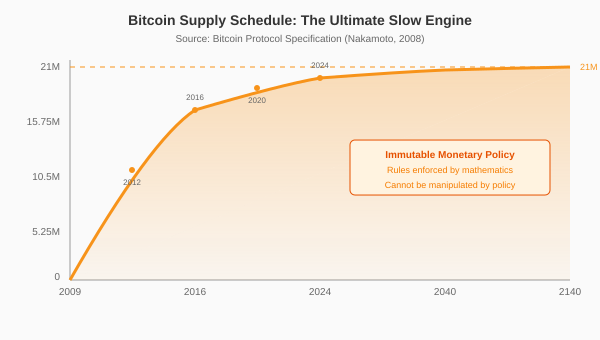
The thermodynamic anchoring is crucial. Bitcoin's proof-of-work consensus mechanism requires physical energy expenditure to validate transactions and create new coins. This creates what Szabo termed "unforgeable costliness"—the value cannot be counterfeited because the cost of production is embedded in the asset itself [3.7]. You cannot fake energy. This physical constraint provides the foundation for reliable long-term value storage that no political promise can match.
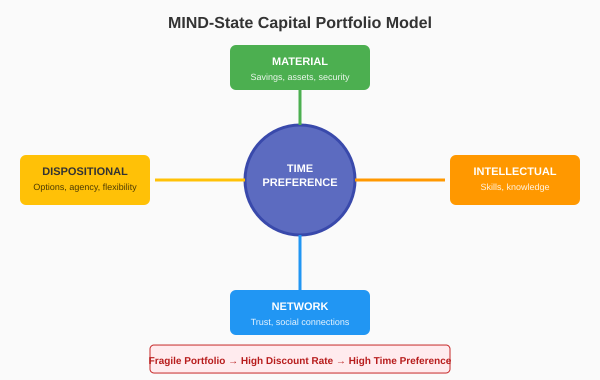
Sound money preserves purchasing power and institutional trust—the conditions that enable low time preference. Bitcoin's preservation of purchasing power across time provides the baseline security necessary for psychological long-term thinking. When individuals can trust that their savings will retain value, the rational calculation shifts toward deferral. Patience becomes rewarded rather than punished.
Table 3.2: Monetary Properties and Time Preference Effects
Property | Fiat Currency | Bitcoin |
Supply Mechanism | Central bank discretion; unlimited | Algorithmic; capped at 21M |
Supply Credibility | Depends on political will | Cryptographically enforced |
Long-term Value | Depreciation expected | Appreciation expected |
Security Basis | Institutional trust; legal force | Thermodynamic (proof-of-work) |
Time Orientation | Present-biased (consume now) | Future-oriented (save/invest) |
Source: Author's analysis based on Ammous (2018) [3.4] and Hoppe (2001) [3.1]
Conclusion
This chapter has established time preference as the root variable determining civilizational trajectory and demonstrated how monetary systems systematically influence aggregate time preference. The evidence suggests that time preference is not merely a fixed individual trait but responds to institutional environment. When property rights are secure, contracts are enforced, and money maintains its value, rational actors can afford to extend their planning horizons.
Fiat monetary systems, through their structural bias toward inflation, systematically raise aggregate time preference. The consequences are visible in declining savings rates, increasing leverage, shortened investment horizons, and the financialization of assets that should serve productive rather than monetary functions. The feedback loop that Hoppe identified operates in reverse: capital consumption rather than accumulation, de-civilization rather than civilization.
Bitcoin offers a technological alternative: a monetary system that enforces low time preference through code and thermodynamics rather than institutional promise. Its fixed supply, predictable issuance, and proof-of-work security create structural incentives for patience, saving, and long-term thinking. Under a Bitcoin standard, the feedback loop can operate as Hoppe described—falling time preference enabling capital accumulation enabling civilizational progress. This represents not merely an alternative monetary arrangement but an alternative relationship with time itself.
References
[3.1] Hoppe, H.-H. (2001). Democracy: The God That Failed. Transaction Publishers.
[3.2] Böhm-Bawerk, E. v. (1884). Capital and Interest. Macmillan.
[3.3] Mises, L. v. (1949). Human Action: A Treatise on Economics. Yale University Press.
[3.4] Ammous, S. (2018). The Bitcoin Standard: The Decentralized Alternative to Central Banking. Wiley.
[3.5] Shoda, Y., Mischel, W., & Peake, P. K. (1990). Predicting adolescent cognitive and self-regulatory competencies from preschool delay of gratification. Developmental Psychology, 26(6), 978–986.
[3.6] U.S. Bureau of Labor Statistics. (2026). Consumer Price Index Historical Data. Retrieved from https://www.bls.gov/cpi/
[3.7] Szabo, N. (2005). Bit Gold. Unenumerated (blog).
[3.8] Nakamoto, S. (2008). Bitcoin: A Peer-to-Peer Electronic Cash System. Retrieved from https://bitcoin.org/bitcoin.pdf
[3.9] Homer, S., & Sylla, R. (2005). A History of Interest Rates (4th ed.). Wiley.
Page