Part 5: CONVERGENCE · Chapter 12
Strategic Bitcoin Reserve: Monetary Sovereignty in the Age of Artificial Intelligence
Beyond the Compute Arms Race
The conventional framing of the 'AGI race' focuses almost exclusively on hardware metrics: GPU stockpiles, chip fabrication capabilities, and training compute. China's explicit goal of AI supremacy by 2030, backed by massive state investment and centralized coordination, embodies this logic.[12.1] The underlying assumption: whoever assembles the largest computing clusters will achieve superintelligence first and reap insurmountable advantages.
This chapter challenges that framing. Drawing on Austrian economic theory, institutional trust literature, and the Five Dimensions of Human Agency framework developed in Chapter 13, we argue that computational resources represent necessary but insufficient conditions for beneficial AGI development. The decisive factors lie in institutional characteristics that authoritarian systems structurally cannot replicate: low time preference enabling long term research investment, high trust networks permitting honest collaboration, open information flows accelerating error correction, and the preservation of human agency that makes alignment research meaningful.
The Strategic Bitcoin Reserve emerges from this analysis not as a financial hedge but as civilizational infrastructure: the monetary foundation that preserves the institutional conditions necessary for developing AGI that serves human flourishing rather than narrow interests. This chapter demonstrates why monetary sovereignty, grounded in proof of work thermodynamic security, provides the essential substrate for winning the race that matters, not the race to AGI, but the race to aligned AGI.
The chapter proceeds as follows: Section 12.2 presents the Five Dimensions of Agency framework and its relevance to AGI development. Section 12.3 analyzes why authoritarian systems face structural disadvantages through the lens of Austrian economics and institutional trust theory. Section 12.4 examines Bitcoin as a Schelling point for civilizational coordination. Section 12.5 develops the Strategic Bitcoin Reserve as infrastructure for preserving human agency. Section 12.6 presents game theoretic analysis of sovereign positioning. Section 12.7 connects monetary sovereignty to the AI alignment problem. Section 12.8 traces historical precedents for monetary transitions during technological transformation. Section 12.9 concludes.
The Five Dimensions of Human Agency
Agency, in the philosophical sense, refers to the capacity of an individual to act independently and make free choices.[12.2] This capacity exists along multiple dimensions, each of which can be enhanced or constrained by technological, institutional, and monetary conditions. Chapter 13 develops a comprehensive framework identifying five dimensions of agency that collectively define the scope of human autonomy. This framework proves essential for understanding why certain institutional configurations, and specifically, certain monetary arrangements, determine success in developing beneficial AGI.
Dimension | Definition | AGI Development Relevance |
Economic Agency | Capacity to earn, save, and transact value without intermediation or permission | Enables independent research funding, patient capital allocation, freedom from capture by incumbent interests |
Temporal Agency | Capacity to plan, defer gratification, and make decisions across time horizons | Essential for alignment research requiring decades of patient investment without short term payoffs |
Informational Agency | Capacity to access truthful information and control personal data disclosure | Enables honest failure reporting, rapid error correction, scientific consensus through open debate |
Computational Agency | Capacity to verify digital systems and participate in consensus mechanisms | Provides verification infrastructure resistant to manipulation by superintelligent systems |
Political Agency | Capacity for self determination, freedom from coercion, and exit from unjust systems | Preserves meaningful human choice and oversight as AI capabilities exceed human cognition |
Table 12.1: The Five Dimensions of Human Agency and Their Relevance to Agi Development
The critical insight is that these dimensions exhibit strong complementarities and depend fundamentally on monetary arrangements. Economic agency provides the foundation for temporal agency, since planning across time requires confidence that savings will retain value. Informational agency requires economic independence; researchers dependent on captured funding sources cannot pursue unpopular truths. Computational agency, as established in Chapter 3, requires proof of work systems that anchor digital verification to physical reality. Political agency requires portable, unseizable wealth.[12.3]
Sound money, as Austrian economists from Menger to Mises to Ammous have argued, is not merely a convenient medium of exchange but the foundation of civilizational coordination. A society that degrades its monetary system systematically undermines all five dimensions of agency. The implications for AGI development are profound: the race will be won not by whoever accumulates the most compute, but by whoever maintains the institutional foundations, grounded in monetary sovereignty, that make beneficial AGI possible.
Why Authoritarian Systems Face Structural Disadvantages
The intuition that closed, authoritarian systems should dominate the AGI race appears compelling. Such systems can direct unlimited resources toward strategic priorities, avoid democratic deliberation inefficiencies, suppress competing uses of talent and capital, and maintain secrecy about progress. Yet analysis through Austrian economics and institutional trust theory reveals why this intuition is fundamentally flawed.[12.4]
The Time Preference Problem
Hans Hermann Hoppe's analysis of time preference and civilization provides crucial insight.[12.5] Low time preference (the willingness to defer present consumption for future benefit) enables capital formation, long term planning, and the construction of durable institutions. High time preference produces consumption over saving, short term thinking, and institutional decay.
Authoritarian monetary systems systematically raise time preference. Currency manipulation, capital controls, and the ever present threat of confiscation make long term saving irrational. When citizens cannot trust that their savings will retain value, or even remain in their possession, they rationally shift toward immediate consumption. The aggregate effect is a society oriented toward the present at the expense of the future.
AGI alignment research exemplifies the kind of work that requires extremely low time preference. The payoffs are uncertain, distant, and diffuse. The work requires patient accumulation of knowledge across decades, honest acknowledgment of failures, and willingness to pursue research directions that powerful interests might oppose. Societies with high time preference, induced by unsound money, structurally cannot sustain such efforts.[12.6]
The Trust Deficit
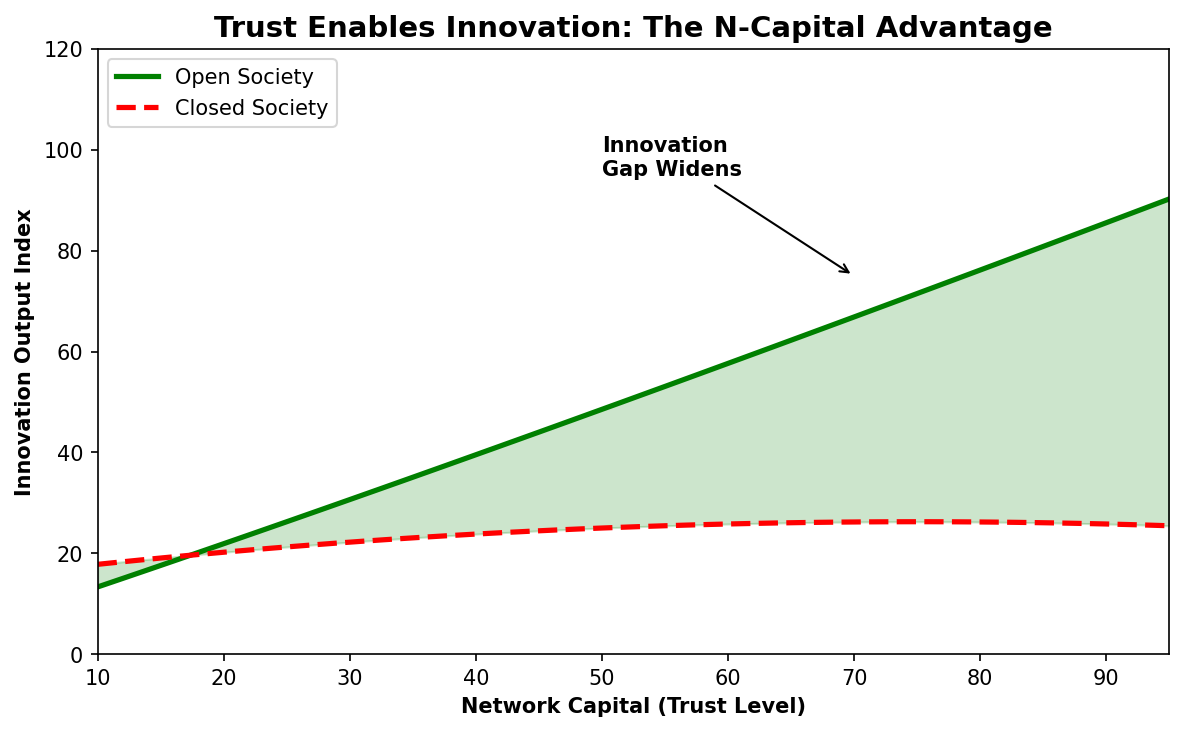
Francis Fukuyama's analysis of trust as the foundation of economic prosperity applies directly to AGI development.[12.7] High trust societies can form complex organizations extending beyond family ties, enabling the kind of cross institutional collaboration that alignment research requires. Low trust societies remain trapped in smaller scale coordination, unable to build the extended networks necessary for tackling civilizational challenges.
Robert Putnam's research on social capital reinforces this analysis.[12.8] Networks of civic engagement create norms of generalized reciprocity that enable cooperation among strangers. Authoritarian systems systematically destroy such networks: surveillance chills association, informant cultures poison trust, and political risk attaches to any collaboration outside official channels.
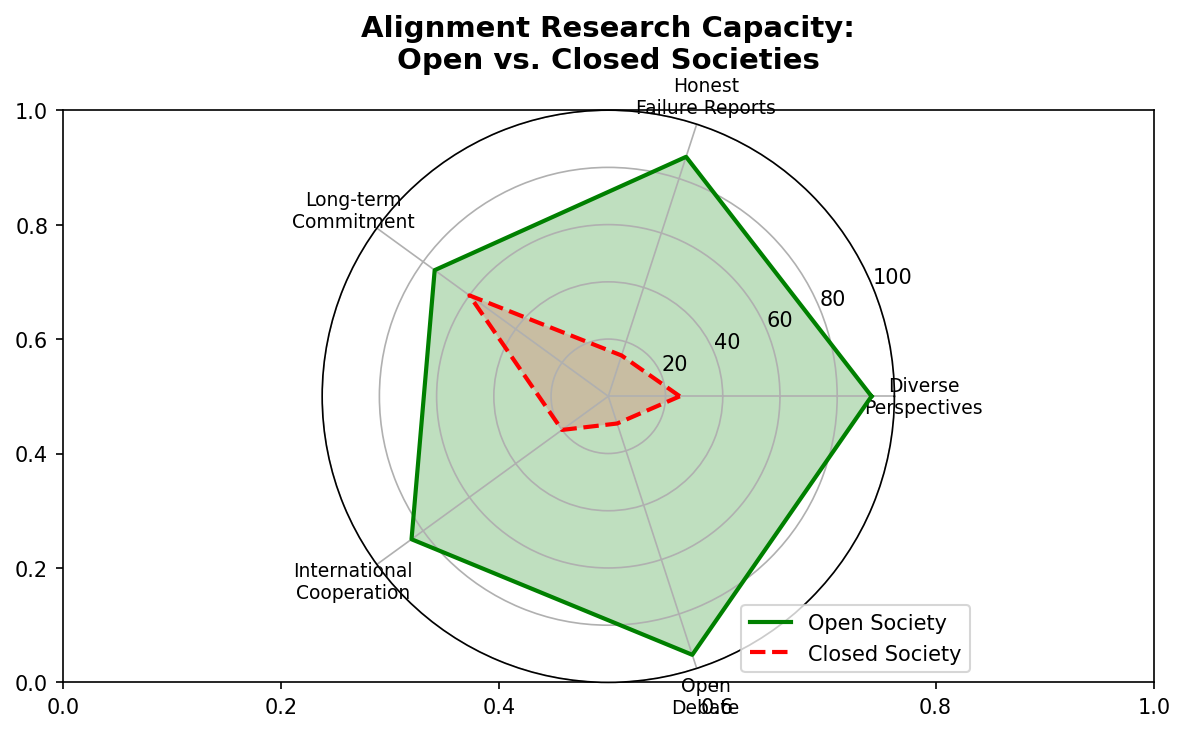
The consequences for AI safety research are severe. Alignment requires researchers to openly share failure modes, honestly assess risks, and collaboratively develop safety measures. These activities presuppose trust that honesty will not be punished, precisely the trust that authoritarian surveillance destroys. A researcher who fears that reporting an AI system's dangerous capability might trigger political consequences will not report it.
Open Source vs. Closed Source Innovation Dynamics
The history of software development provides a powerful analogy for AGI competition. Open source projects like Linux, Apache, and Bitcoin itself have repeatedly outcompeted closed, proprietary alternatives despite the latter's resource advantages.[12.9] The mechanism: open systems enable distributed error correction, attract global talent, and benefit from network effects that closed systems cannot replicate.
Eric Raymond's 'cathedral versus bazaar' distinction captures the dynamic: closed development resembles cathedral construction, where a small group works in isolation toward a predetermined design. Open development resembles a bazaar, where many contributors iterate rapidly, errors are quickly identified and corrected, and the best solutions emerge through competitive selection.
AGI development exhibits similar dynamics. Alignment is not a problem with a known solution that merely requires implementation; it is an open research challenge requiring exploration of vast possibility spaces. Open societies, with their distributed research communities, rapid information flow, and tolerance for heterodox approaches, possess structural advantages in such exploration. Closed societies, despite resource concentration, face the 'cathedral' limitation: their predetermined approaches may miss crucial insights that only emerge from diverse, decentralized investigation.[12.10]
Characteristic | Open Society Advantage | Authoritarian Deficit |
Time Preference | Sound money enables low time preference; patient capital formation | Monetary manipulation raises time preference; short term orientation |
Trust Networks | High social capital; cross institutional collaboration | Surveillance destroys trust; collaboration carries political risk |
Error Correction | Open debate rapidly identifies mistakes; scientific consensus | Official narratives override empirical findings; errors persist |
Talent Dynamics | Global talent attracted by freedom; brain gain | Talent flees or self censors; brain drain |
Research Diversity | Heterodox approaches tolerated; edge cases explored | Approved directions only; systematic blind spots |
Table 12.2: Structural Comparison of Open Societies vs. Authoritarian Systems in Agi Development
Bitcoin as Schelling Point for Civilizational Coordination
Thomas Schelling's game theoretic analysis of focal points provides crucial insight into Bitcoin's role in AGI era coordination.[12.11] In coordination games with multiple equilibria, participants converge on 'Schelling points,' solutions that stand out due to salient characteristics even without explicit communication. Bitcoin possesses multiple properties establishing it as the Schelling point for preserving human agency through the AGI transition.
Network Effects and Monetary Convergence
Carl Menger's theory of money's emergence explains why monetary systems exhibit strong network effects.[12.12] Money's utility derives from the expectation that others will accept it; each additional user increases value for all existing users. This creates winner take most dynamics where the most salable good (the one with the best monetary properties) gradually absorbs the monetary premium from inferior alternatives.
Bitcoin's network effects compound across multiple dimensions: miners secure the network, creating trust that attracts users; users create demand, attracting developers; developers improve functionality, attracting institutional adoption; institutional adoption creates legitimacy, attracting regulatory clarity. Each reinforcing loop strengthens Bitcoin's position as the Schelling point for digital money.[12.13]
Agency Preservation Through Monetary Architecture
Bitcoin's technical properties map directly to the Five Dimensions of Agency:
Economic Agency: Self custody eliminates dependence on financial intermediaries. Anyone with a private key controls their bitcoin absolutely, without permission from banks, governments, or payment processors.
Temporal Agency: Fixed supply (21 million cap) and predictable issuance schedule enable long term planning. Savers know exactly how the monetary base will evolve for the next century.
Informational Agency: Pseudonymous transactions provide financial privacy while the public blockchain enables verification. Users can prove solvency without revealing holdings.
Computational Agency: Full node operation enables independent verification of the entire monetary system. Users need not trust any institution; they can verify everything themselves.
Political Agency: Censorship resistance ensures transactions cannot be blocked by any authority. Memorizable seed phrases enable wealth to cross any border without detection.[12.14]
Strategic Bitcoin Reserve as Agency Preservation Infrastructure
The Strategic Bitcoin Reserve transcends conventional concepts of reserve assets. Within the agency preservation framework, sovereign bitcoin accumulation represents infrastructure investment for AGI competition: the monetary foundation enabling a society to maintain the openness, trust, and preserved agency required to win.[12.15]
The Preservation Function
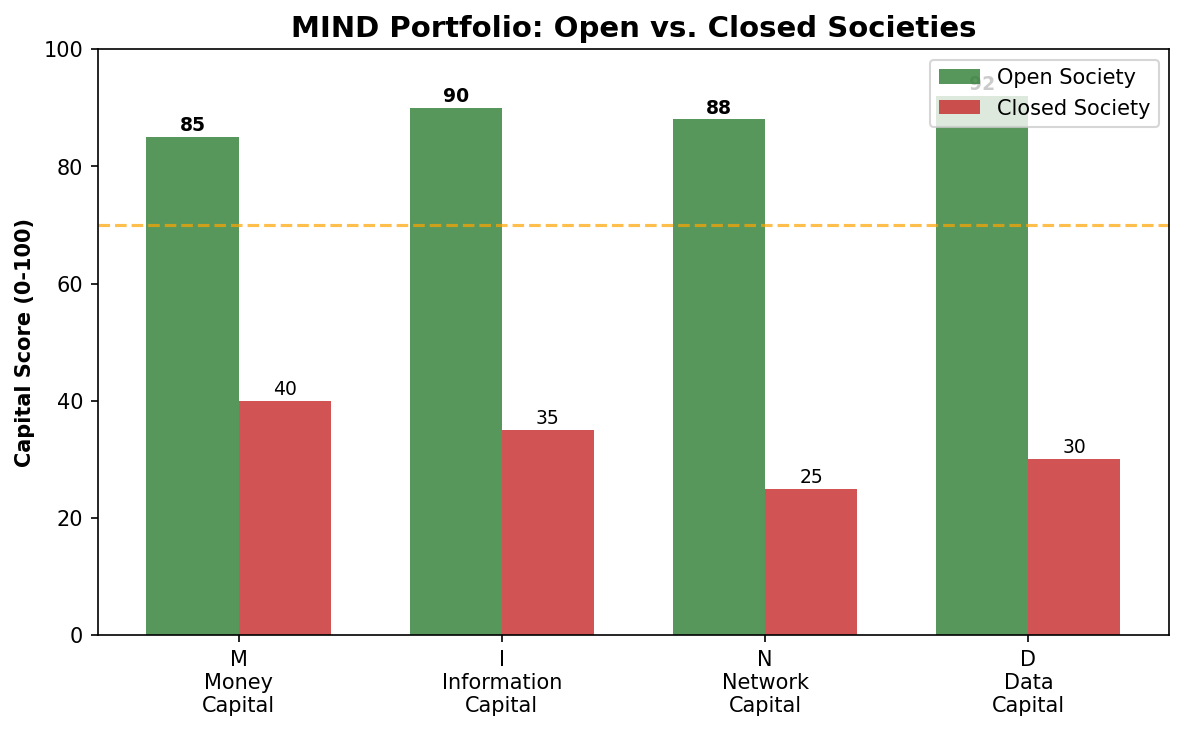
Open societies face a structural vulnerability in the AGI race. Their very openness, the source of their institutional strength, makes them susceptible to exploitation by closed competitors. Authoritarian systems can leverage open society research while protecting their own efforts. They can attract talent trained in open environments while restricting return flows.[12.16]
The Strategic Bitcoin Reserve provides defensive infrastructure against these asymmetric vulnerabilities. By holding substantial reserves in an asset that cannot be sanctioned, frozen, or devalued by external actors, nations preserve capacity for independent action. This monetary sovereignty enables continued investment in open institutions even during geopolitical stress. The reserve functions as a civilizational insurance policy, ensuring that the institutional foundations for beneficial AGI remain funded regardless of external pressures.
The Signaling Function
Sovereign bitcoin accumulation signals commitment to monetary integrity over unlimited time horizons. Unlike fiat reserves printable at will, bitcoin holdings represent genuine sacrifice: accumulation of scarce resources that could have been spent elsewhere. Game theory recognizes such costly signals as credible precisely because they cannot be cheaply faked.[12.17]
Talent Attraction: Researchers and engineers seeking stable, long term environments gravitate toward nations demonstrating commitment to monetary stability. The brain drain afflicting monetarily unstable societies reverses.
Patient Capital: Long term investors require confidence returns will not be inflated away. Nations with substantial bitcoin reserves demonstrate the low time preference attracting patient capital for research infrastructure.
International Cooperation: Alignment is a global challenge requiring global cooperation. Bitcoin reserves, verifiable on chain by any party, provide credible evidence of good faith that traditional diplomatic assurances cannot match.[12.18]
SBR Function | Mechanism | Agency Dimension | AGI Advantage |
Debasement Hedge | Fixed supply asset in treasury | Temporal (low time pref.) | Sustained R&D investment |
Sanction Resistance | Unseizable reserve asset | Political (exit capacity) | Continued collaboration |
Verification Infrastructure | Proof of work anchoring | Computational (verify) | AI resistant systems |
Talent Attraction | Signals long term commitment | Informational (quality) | Research leadership |
Economic Independence | Self custody reserves | Economic (autonomy) | Funding independence |
Table 12.3: Strategic Bitcoin Reserve Functions Mapped to Agency Dimensions
Game Theory of the Agi Race
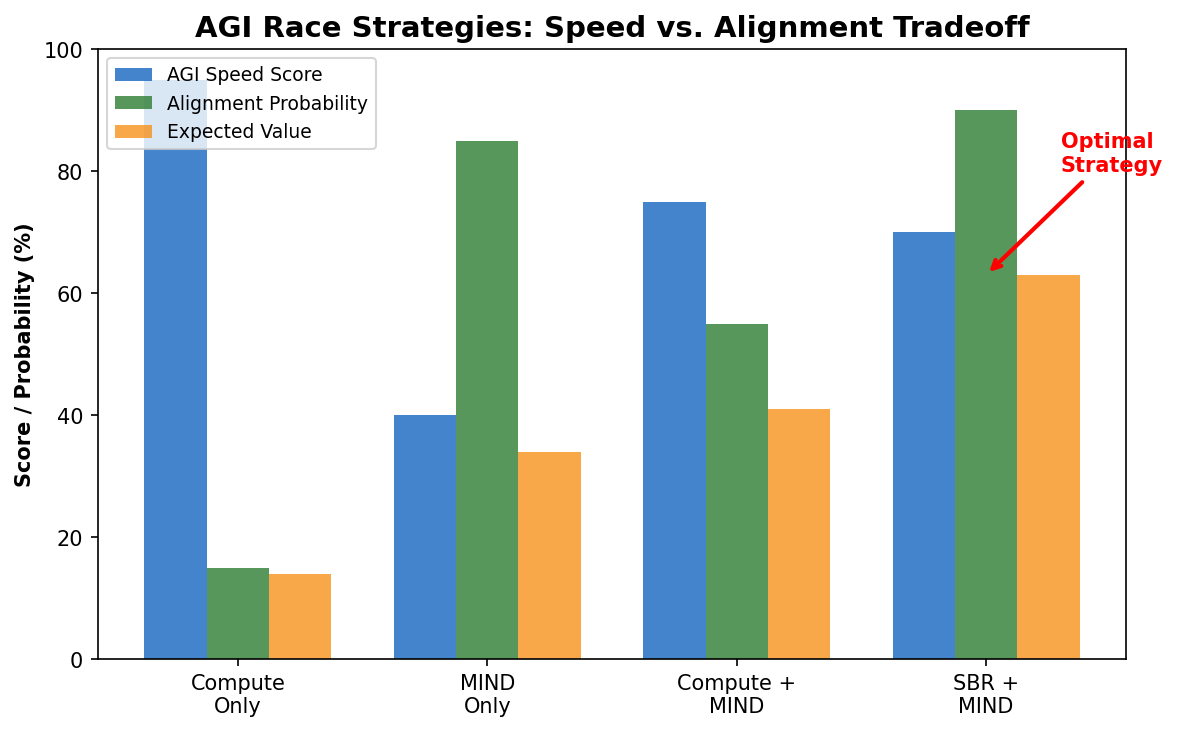
The AGI race context transforms the game theory of sovereign bitcoin accumulation. Traditional analysis focuses on reserve asset diversification and inflation hedging. The agency preservation framework reveals deeper strategic dynamics with civilizational stakes.[12.19]
The Alignment Dilemma
Nations face a fundamental strategic choice: prioritize short term computational advantages or invest in the institutional foundations necessary for beneficial AGI. This creates a multi player game with asymmetric payoffs:[12.20]
Scenario A (Compute Race Only): All nations focus exclusively on GPU accumulation, neglecting institutional foundations. The 'winner' achieves powerful but potentially unaligned AGI. Outcome is potentially catastrophic for all players, including the 'winner.'
Scenario B (Agency Preservation Investment): Nations that invest in monetary sovereignty, open institutions, and trust networks may trail in raw compute but lead in alignment capability. If any player achieves aligned AGI, that player achieves sustainable advantage.
Scenario C (Mixed Strategy): Some nations pursue pure compute while others maintain agency preserving institutions. The race becomes alignment versus unalignment, with civilizational stakes depending on which approach achieves AGI first.[12.21]
Strategy Combination | Likely Outcome | Global Welfare |
All pursue compute only | Unaligned AGI emerges | Potentially catastrophic |
All preserve agency institutions | Aligned AGI emerges (slower) | Optimal (positive sum) |
Mixed strategies | Race between aligned/unaligned | Uncertain (timing dependent) |
Leader invests SBR + institutions | Leader achieves aligned AGI first | Optimal for leader, beneficial for all |
Table 12.4: Agi Race Game Theory Matrix, Institutional Investment vs. Pure Compute
First Mover Advantages
The Strategic Bitcoin Reserve offers unique first mover advantages in the AGI race context:[12.22]
Supply Scarcity: Only 21 million bitcoin will ever exist. Early accumulating nations secure larger shares of this fixed resource. As the connection between monetary sovereignty and agency preservation becomes clearer, competition for limited supply will intensify.
Infrastructure Lead: Building custody, integration, and policy frameworks for sovereign bitcoin management takes years. Nations beginning accumulation now develop institutional capacity that cannot be rapidly replicated.
Talent Magnetism: The signaling effect of early SBR adoption attracts forward thinking researchers and institutions. This human capital accumulation compounds over time, creating durable advantages.[12.23]
Current Sovereign Positioning
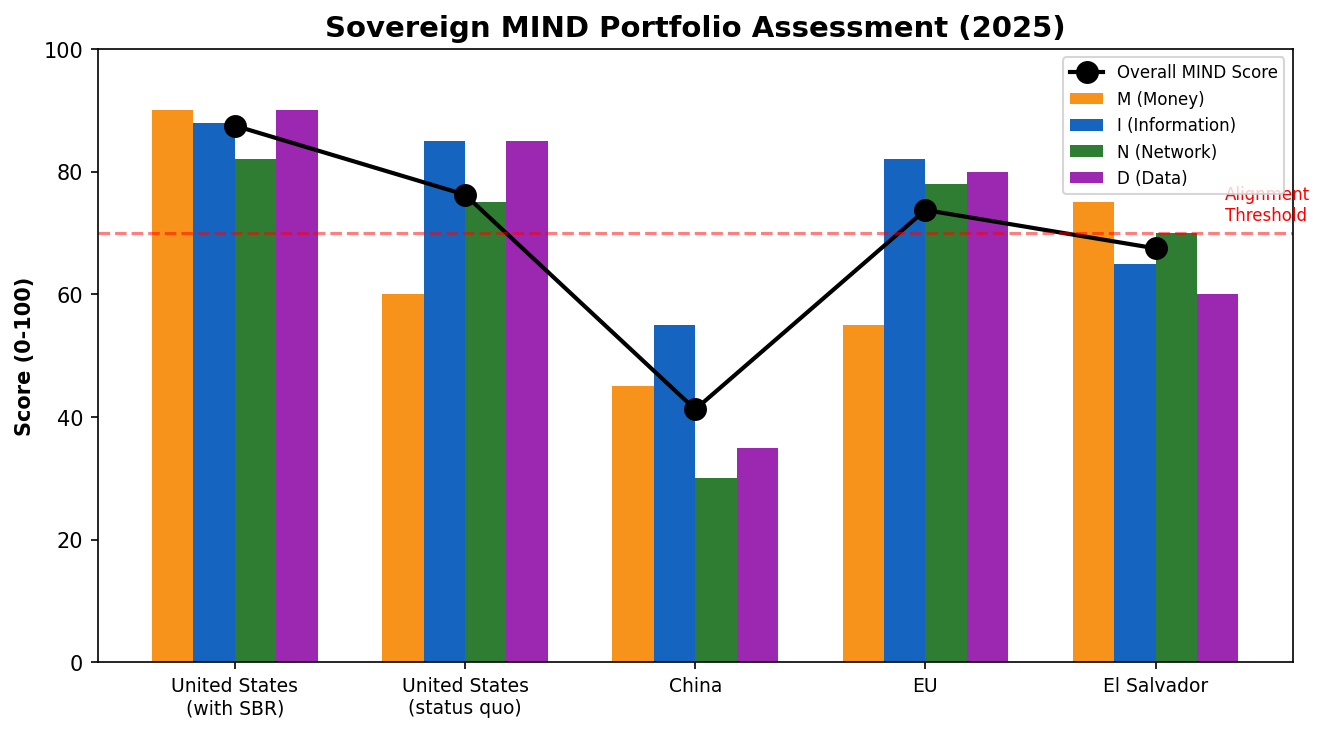
Nation | SBR Status | Holdings | Institutional Assessment |
United States | Active | ~200K BTC* | Strong agency institutions; SBR reinforces all five dimensions |
El Salvador | Pioneer | 6,000+ BTC | Economic agency strengthening; other dimensions developing |
China | Restricted | ~190K (seized) | Compute focused; trust and political agency structurally constrained |
European Union | Debating | Minimal | Strong information/political agency; economic agency vulnerable |
UAE/Gulf | Building | Undisclosed | Economic agency diversifying; political agency moderate |
Table 12.5: Sovereign Bitcoin Positioning and Agency Assessment (as of early 2025). *US holdings primarily from seizures; SBR policy evolving.
The Alignment Problem Requires Open Societies
The connection between Strategic Bitcoin Reserves and AGI alignment runs deeper than institutional preservation. The alignment problem (ensuring superintelligent systems remain beneficial to humanity) is fundamentally a challenge that only open societies with preserved human agency can address.[12.24]
Alignment as Value Aggregation
Aligning AGI with human values presupposes determining what human values are. This is not a technical problem with a technical solution. It is a social and political challenge requiring mechanisms to aggregate diverse preferences across billions of humans with conflicting interests, values, and worldviews.[12.25]
Open societies have developed such mechanisms over centuries: democratic deliberation, free press, academic freedom, market price signals, civil society, and legal systems protecting dissent. These institutions depend on all five dimensions of agency: economic independence to fund diverse viewpoints, temporal stability to sustain long term deliberation, informational freedom to surface genuine preferences, computational verification to establish shared facts, and political agency to ensure participation is meaningful.
An AGI system aligned with values as defined by any single political authority, rather than through genuine deliberation, risks fundamental misalignment with the broader population whose preferences cannot be freely expressed. Only societies maintaining robust mechanisms for genuine preference revelation can produce AGI aligned with actual human values.[12.26]
Alignment as Iterative Correction
Alignment is not a one time achievement but an ongoing process of identifying failures and correcting course. This iterative process requires institutional foundations that authoritarian systems structurally cannot provide:[12.27]
Honest Failure Reporting: Researchers must report near misses and concerning behaviors without fear of punishment. This requires high trust networks where honesty is rewarded rather than punished.
Diverse Testing Perspectives: Systems must be probed from multiple viewpoints to identify blind spots. This requires informational agency, the freedom to explore heterodox perspectives.
Long term Commitment: Alignment work often lacks short term payoffs and requires patient investment. This requires temporal agency, monetary stability enabling long time horizons.
Independent Funding: Researchers pursuing unpopular but important directions need funding independent of captured institutions. This requires economic agency, the capacity to accumulate and deploy resources without permission.[12.28]
Sbr as Alignment Infrastructure
The Strategic Bitcoin Reserve directly supports alignment capacity by strengthening the monetary foundation upon which all five dimensions of agency rest:[12.29]
Funding Independence: Alignment research can be funded through appreciation of bitcoin reserves rather than capture prone mechanisms. This enables pursuit of unpopular but important research directions.
International Cooperation: Alignment is a global challenge requiring global cooperation. Bitcoin reserves enable continued collaboration even during geopolitical stress when traditional payment rails may be weaponized.
Generational Commitment: Alignment may require decades of patient work. Bitcoin's properties as a multigenerational store of value enable credible commitment to research programs outlasting individual researchers, administrations, or political systems.[12.30]
Historical Precedents: Monetary Transitions During Technological Transformation
History provides instructive precedents for understanding how monetary arrangements interact with transformative technological change. These precedents illuminate both the dynamics of monetary transition and the stakes involved in the current moment.[12.31]
The Classical Gold Standard and Industrial Revolution
The period from 1870 to 1914 saw both the classical gold standard and the Second Industrial Revolution unfold simultaneously. Sound money, with currencies backed by gold at fixed rates, provided the stable foundation for unprecedented capital formation and technological development. Interest rates declined secularly as capital accumulated; infrastructure investments spanning decades became rational; trust networks extended across borders.
The industrial transformation created deflationary pressure as productivity soared, yet this 'good deflation' was transmitted to consumers through falling prices rather than absorbed through monetary manipulation. The gold standard's constraint on money creation forced productivity gains to manifest as real wealth increases.[12.32]
The Bretton Woods Transition
The transition from British pound sterling to U.S. dollar as primary reserve currency required approximately fifty years, from the pound's peak dominance around 1914 to clear dollar hegemony by the 1960s. The transition was neither linear nor immediate; the pound retained significant reserve status well into the postwar period despite Britain's diminished economic position.[12.33]
This precedent suggests that monetary transitions, even when the successor's advantages are clear, unfold over generational timeframes. Early positioning creates compounding advantages; late positioning faces closing windows. The nations that accumulated dollar reserves early in the transition secured advantages that persist to this day.
Implications for the Current Transition
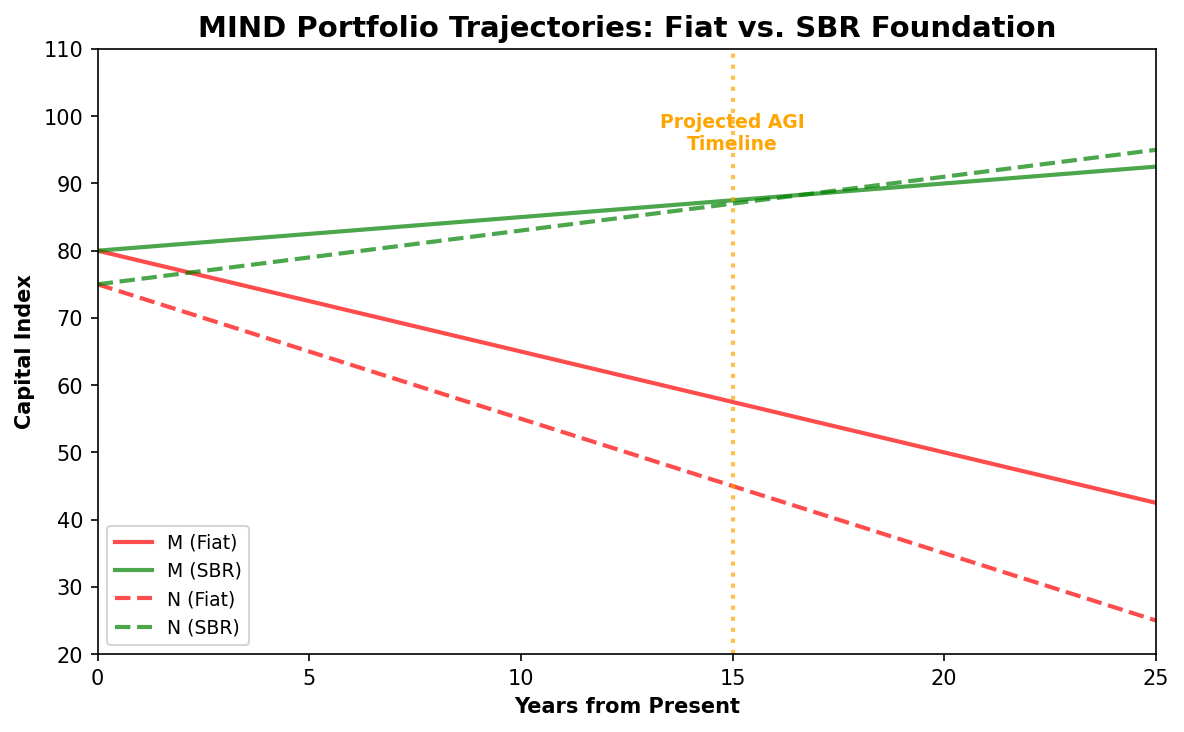
The current moment combines monetary transition (from fiat to Bitcoin anchored systems) with technological transformation (the emergence of AGI) in ways that amplify both phenomena. AGI creates deflationary pressure that fiat systems cannot accommodate, as detailed in Chapter 9. Simultaneously, AGI creates verification challenges that only proof of work can address, as established in Chapter 3.[12.34]
Historical precedents suggest that nations positioning early for this dual transition will secure advantages that compound over decades. The Strategic Bitcoin Reserve represents precisely such early positioning: accumulating the monetary asset best suited for both technological deflation and AI era security before the necessity becomes universally apparent.
The Race Worth Winning
The Great AGI Race will not be won by the nation with the most GPUs. It will be won by the society that maintains the institutional foundations necessary for beneficial superintelligence: low time preference enabling patient research, high trust networks permitting honest collaboration, open information flows accelerating error correction, and preserved human agency making alignment meaningful.[12.35]
Austrian economics illuminates why sound money provides the foundation for these institutional characteristics. Fukuyama and Putnam's trust research explains why authoritarian systems face structural disadvantages despite resource concentration. The open source versus closed source analogy reveals why distributed, diverse research communities outperform centralized alternatives. The Five Dimensions of Agency framework, developed in Chapter 13, provides the comprehensive lens for understanding what must be preserved through the AGI transition.
Closed, authoritarian systems may accumulate computational resources, but they structurally cannot foster the trust, openness, and human agency that alignment requires. Their deficits ensure that any AGI they produce carries elevated risks of misalignment, optimized for control rather than human flourishing.[12.36]
The Strategic Bitcoin Reserve provides the monetary foundation for maintaining the institutional characteristics open societies require. By securing wealth in an incorruptible, unseizable, verifiable asset, nations preserve capacity for the long term thinking, international cooperation, and honest inquiry that solving alignment demands.
The race to establish a Strategic Bitcoin Reserve is not merely a competition for reserve assets. It is a race to build the civilizational infrastructure necessary for beneficial superintelligence. The nation that succeeds, by accumulating bitcoin early, maintaining open institutions, and preserving human agency across all five dimensions, will not merely survive the AGI transition. It will thrive, potentially leading humanity into an era of unprecedented flourishing.[12.37]
This is the race worth winning. This is why monetary sovereignty matters. And as the preceding chapters have argued, from the thermodynamic security of proof of work (Chapter 3) to the structural incompatibility of fiat with technological deflation (Chapter 9), this is why Bitcoin, fundamentally, is about time.
References
[12.1] Lee, K. (2018). AI Superpowers: China, Silicon Valley, and the New World Order. Houghton Mifflin.
[12.2] Hoppe, H. H. (2001). Democracy: The God That Failed. Transaction Publishers. See also Chapter 13's development of the Five Dimensions of Agency framework.
[12.3] Ammous, S. (2018). The Bitcoin Standard: The Decentralized Alternative to Central Banking. Wiley.
[12.4] Acemoglu, D. & Robinson, J. (2012). Why Nations Fail: The Origins of Power, Prosperity, and Poverty. Crown Business.
[12.5] Hoppe, H. H. (2001). Op. cit. See especially chapters on time preference and civilization.
[12.6] Mises, L. v. (1949). Human Action: A Treatise on Economics. Yale University Press.
[12.7] Fukuyama, F. (1995). Trust: The Social Virtues and the Creation of Prosperity. Free Press.
[12.8] Putnam, R. (2000). Bowling Alone: The Collapse and Revival of American Community. Simon & Schuster.
[12.9] Raymond, E. (1999). The Cathedral and the Bazaar: Musings on Linux and Open Source by an Accidental Revolutionary. O'Reilly Media.
[12.10] Weber, S. (2004). The Success of Open Source. Harvard University Press.
[12.11] Schelling, T. (1960). The Strategy of Conflict. Harvard University Press.
[12.12] Menger, C. (1892). 'On the Origin of Money.' Economic Journal 2(6), 239 to 255.
[12.13] Metcalfe, B. (2013). 'Metcalfe's Law after 40 Years of Ethernet.' IEEE Computer 46(12).
[12.14] Gladstein, A. (2022). Check Your Financial Privilege. BTC Media.
[12.15] Lowery, J. (2023). Softwar: A Novel Theory on Power Projection and the National Strategic Significance of Bitcoin. MIT Press.
[12.16] Allison, G. (2017). Destined for War: Can America and China Escape Thucydides's Trap? Houghton Mifflin Harcourt.
[12.17] Spence, M. (1973). 'Job Market Signaling.' Quarterly Journal of Economics 87(3).
[12.18] Ostrom, E. (1990). Governing the Commons: The Evolution of Institutions for Collective Action. Cambridge University Press.
[12.19] Bostrom, N. (2014). Superintelligence: Paths, Dangers, Strategies. Oxford University Press.
[12.20] Russell, S. (2019). Human Compatible: Artificial Intelligence and the Problem of Control. Viking.
[12.21] Armstrong, S., et al. (2016). 'Racing to the Precipice: A Model of Artificial Intelligence Development.' AI & Society 31(2).
[12.22] Fidelity Digital Assets (2024). 'Institutional Bitcoin Infrastructure Report.'
[12.23] World Economic Forum (2024). 'Global Talent Competitiveness Index.'
[12.24] Gabriel, I. (2020). 'Artificial Intelligence, Values, and Alignment.' Minds and Machines 30(3).
[12.25] Sen, A. (1999). Development as Freedom. Oxford University Press.
[12.26] Rawls, J. (1971). A Theory of Justice. Harvard University Press.
[12.27] Amodei, D. (2024). 'Machines of Loving Grace.' Anthropic Research.
[12.28] Christiano, P. (2023). 'What Failure Looks Like.' AI Alignment Forum.
[12.29] Tegmark, M. (2017). Life 3.0: Being Human in the Age of Artificial Intelligence. Knopf.
[12.30] Drexler, K. (2019). 'Reframing Superintelligence: Comprehensive AI Services as General Intelligence.' Future of Humanity Institute Technical Report.
[12.31] Eichengreen, B. (2008). Globalizing Capital: A History of the International Monetary System (2nd ed.). Princeton University Press.
[12.32] Bordo, M. & Schwartz, A. (1999). 'Monetary Policy Regimes and Economic Performance.' Handbook of Macroeconomics 1, 149 to 234.
[12.33] Eichengreen, B. (2011). Exorbitant Privilege: The Rise and Fall of the Dollar and the Future of the International Monetary System. Oxford University Press.
[12.34] See Chapter 9: The Structural Paradox of Technological Deflation.
[12.35] Ord, T. (2020). The Precipice: Existential Risk and the Future of Humanity. Hachette.
[12.36] Henrich, J. (2020). The WEIRDest People in the World: How the West Became Psychologically Peculiar and Particularly Prosperous. Farrar, Straus and Giroux.
[12.37] Connecting to the book's central thesis developed across Chapters 2 through 4 on Bitcoin and time.